The question is a small business loan installment or revolving arises because business financing is offered in more than one structural format. A small business loan can be installment-based, revolving, or structured in a hybrid form, depending on how the funds are issued, how repayment is scheduled, and how the loan balance changes over time. Understanding the distinction requires examining how each loan structure functions, how lenders define repayment obligations, and how interest is applied throughout the loan term.
This explanation focuses on factual definitions and mechanics rather than suitability or preference. The goal is to clarify how installment and revolving structures differ within the context of a small business loan.
What a Small Business Loan Means
A small business loan is a financing arrangement in which a lender provides capital to a business entity with the expectation of repayment under agreed terms. These loans are used for operating expenses, asset purchases, inventory, expansion, or general business purposes. The defining characteristics of a small business loan include the loan amount, interest charges, repayment structure, and duration of the loan term.
From a structural perspective, small business loans fall into two primary categories: installment loans and revolving credit. Each category determines how funds are accessed, how monthly payments are calculated, and how the loan balance behaves over time.
The confusion often arises because the term “small business loan” is used broadly. It does not, by itself, specify whether the financing is installment or revolving. That distinction depends on the underlying loan agreement.
What Is an Installment Business Loan
An installment business loan is a loan in which the borrower receives a fixed amount of money upfront and repays it through scheduled payments over a defined loan term. These payments typically include both principal and interest and follow a fixed repayment schedule.
Once the loan is disbursed, the full loan balance is established. The borrower does not re-borrow amounts that have already been repaid. As payments are made, the loan balance steadily decreases until it reaches zero at the end of the loan term.
Installment loans are often referred to as term loans in business financing contexts. The defining elements include:
- A single disbursement of funds
- A predetermined loan term
- Regular monthly payments
- A declining loan balance
- Principal and interest included in each payment
Because the repayment structure is fixed, the borrower knows the payment amount and the payoff date from the beginning. The borrowing limit is not reusable once principal is repaid.
What Is a Revolving Business Loan
A revolving business loan operates differently. Instead of receiving a one-time lump sum, the borrower gains access to a reusable credit limit. This structure is commonly described as revolving credit.
With revolving credit, the lender sets a borrowing limit, and the business can draw funds as needed up to that limit. As borrowed amounts are repaid, the available credit replenishes, allowing the borrower to draw funds again without applying for a new loan.
A business line of credit is the most common example of a revolving business loan. Its defining features include:
- A reusable credit limit
- Flexible borrowing and repayment
- Interest charges based on the outstanding balance
- No fixed payoff date tied to a single disbursement
- Variable loan balance over time
Unlike installment loans, revolving credit does not require full utilization of the borrowing limit. Interest is typically calculated only on the amount currently borrowed, not the total available credit.
Key Differences Between Installment and Revolving Business Loans
The distinction between installment and revolving structures lies in how funds are accessed and repaid. The table below conceptually summarizes these differences, which are further explained in detail throughout this article.
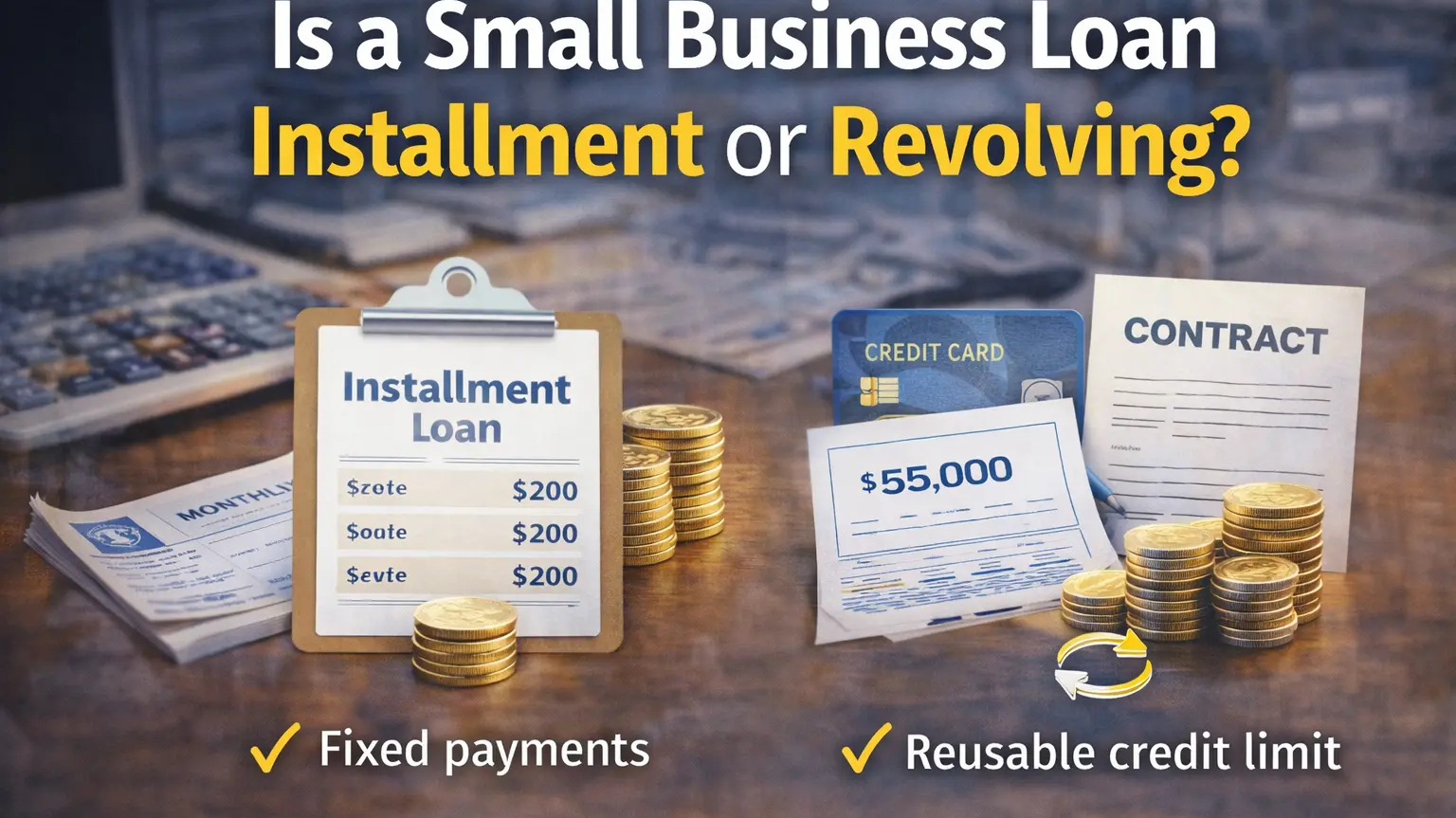
Installment loans involve a fixed amount and a fixed repayment schedule. Revolving loans involve a credit limit that can be reused as balances are paid down.
Other core differences include:
- Loan balance behavior
- Payment predictability
- Borrowing flexibility
- Interest calculation
These differences explain why the question “is a small business loan revolving or installment” does not have a single universal answer.
How Banks Structure Small Business Loans
When examining whether is a small business loan from bank installment or revolving, the answer depends on the specific product offered. Banks commonly provide both installment-based and revolving business financing.
Installment-based bank loans typically take the form of term loans. These loans are issued with a defined loan term, a fixed repayment schedule, and structured monthly payments. Once the loan is funded, the structure does not change unless modified through refinancing or restructuring.
Revolving bank loans are typically structured as business lines of credit. These allow businesses to draw funds repeatedly within an approved borrowing limit. The loan balance fluctuates based on usage and repayment.
Banks define these structures clearly in loan documentation. The classification is based on repayment mechanics rather than the purpose of the loan or the size of the business.
How Repayment Works for Each Loan Type
Business loan repayment differs significantly between installment loans and revolving credit.
Installment Loan Repayment
Installment loan repayment follows a fixed repayment schedule. Payments are usually made monthly and remain consistent throughout the loan term. Each payment reduces the principal while also covering interest charges.
Key characteristics include:
- Fixed monthly payments
- Scheduled payoff date
- Gradual reduction of loan balance
- No re-borrowing after repayment
Because the schedule is predetermined, the repayment structure is predictable and does not change based on borrowing behavior after disbursement.
Revolving Credit Repayment
Revolving credit repayment is more flexible. Payments may vary depending on the outstanding balance. As funds are borrowed and repaid, the loan balance changes, and available credit increases or decreases accordingly.
Common repayment elements include:
- Payments based on current balance
- Reusable borrowing limit
- Ongoing access to funds
- Interest charges calculated on outstanding amounts
Revolving credit does not have a single amortization schedule tied to a fixed loan amount.
How Loan Structure Affects Interest and Loan Balance
The structure of a small business loan installment or revolving credit directly affects how interest charges accrue and how the loan balance behaves over time.
With installment loans, interest is calculated based on the outstanding principal according to the loan’s amortization schedule. Early payments typically allocate more toward interest, while later payments focus more on principal reduction. The loan balance declines predictably with each payment.
With revolving credit, interest is calculated based on the current loan balance at any given time. If no funds are drawn, interest charges may be minimal or nonexistent. If funds are borrowed repeatedly, interest accrues on the outstanding amount until it is repaid.
The difference in interest calculation is structural, not discretionary. It reflects whether the loan is designed as a fixed obligation or a flexible financing option.
When a Business Loan Is Installment vs Revolving
Determining whether is a small business loan an installment or revolving depends on the loan’s formal structure, not the borrower’s intended use of funds.
A business loan is installment-based when:
- Funds are disbursed in a lump sum
- Repayment follows a fixed schedule
- The loan term has a defined end date
- The loan balance decreases steadily
A business loan is revolving when:
- Funds are accessed as needed
- The borrowing limit replenishes after repayment
- Payments vary based on usage
- The loan balance fluctuates
Some financing arrangements may include elements of both structures, but the underlying classification still depends on how repayment and borrowing are defined in the loan agreement.
Frequently Asked Questions
Is a small business loan installment or revolving?
A small business loan can be either installment or revolving. The classification depends on whether the loan provides a fixed amount with scheduled repayment or a reusable credit limit with flexible borrowing.
How does an installment business loan work?
An installment business loan provides a lump sum that is repaid through fixed monthly payments over a set loan term. Each payment includes principal and interest, and the loan balance decreases until fully repaid.
How does a revolving business loan work?
A revolving business loan provides access to a borrowing limit that can be used, repaid, and reused. Interest charges apply to the outstanding balance, and the loan balance changes based on borrowing activity.
Is a small business loan from a bank installment or revolving?
A small business loan from a bank may be installment-based or revolving. Banks offer term loans as installment loans and lines of credit as revolving loans.
What is the difference between installment and revolving business loans?
The difference lies in fund access and repayment. Installment loans have fixed payments and a declining balance, while revolving loans have flexible borrowing and a reusable credit limit.
Which type of business loan has fixed monthly payments?
Installment loans have fixed monthly payments based on a predetermined repayment schedule.
Summary of Key Points
A small business loan is not inherently installment or revolving. The distinction depends on the loan structure defined in the financing agreement.
Installment loans involve a fixed amount, fixed repayment schedule, and declining loan balance. Revolving credit involves a reusable borrowing limit, flexible repayment, and variable loan balance.
Banks and other lenders offer both structures under the broad category of small business loans. Understanding the mechanics of each structure clarifies how business loan repayment, interest charges, and loan balances are determined over time.