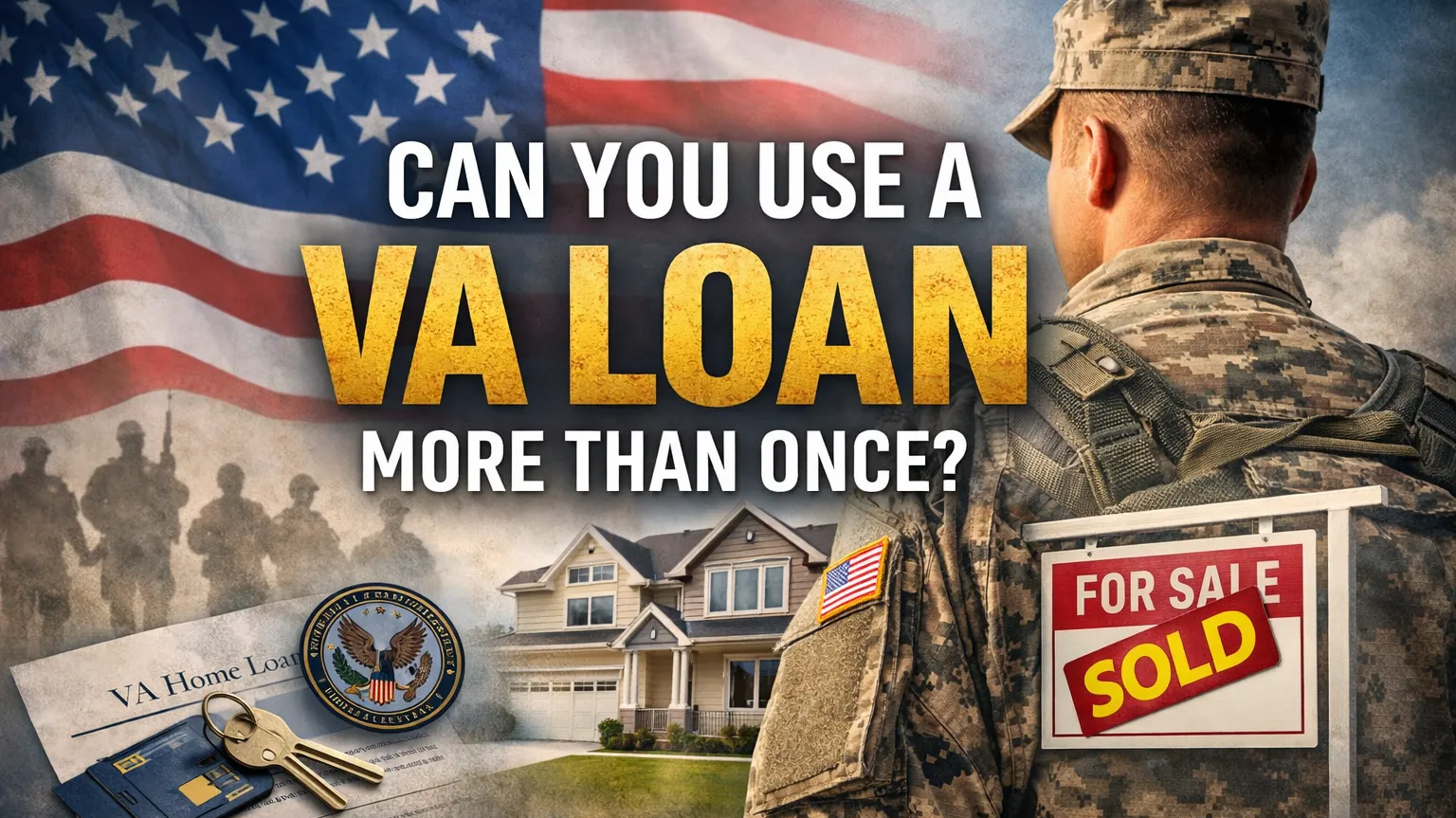
VA home loans remain one of the most valuable mortgage benefits available to eligible U.S. service members, veterans, and certain surviving spouses. Backed by the Department of Veterans Affairs, these loans offer competitive interest rates, no required down payment in most cases, and no private mortgage insurance.
A common misconception is that this benefit can only be used once. That is incorrect. The answer to “Can you use a VA loan more than once?” is yes — provided you understand how VA loan entitlement works. Borrowers may reuse a VA loan after selling a home, refinance and use it again, or even hold two VA loans at the same time under specific circumstances. The key factors include entitlement restoration, remaining entitlement, and county loan limits.
Understanding these rules allows borrowers to maximize their benefit without unnecessary delays or down payment surprises.
Understanding VA Loan Entitlement
VA loan entitlement refers to the amount the Department of Veterans Affairs guarantees on a borrower’s behalf. This guaranty reduces lender risk and allows qualified borrowers to obtain favorable loan terms.
Basic Entitlement
Basic entitlement is $36,000. The VA guarantees up to 25% of the loan amount. While $36,000 may appear low, it represents the portion of a loan up to $144,000 (25% of $144,000 equals $36,000).
This is not the maximum loan amount. Instead, it represents the guaranteed portion lenders rely on when approving loans.
Bonus Entitlement
Most modern VA borrowers rely on bonus entitlement, also called Tier 2 entitlement. This applies to loans exceeding $144,000 and aligns with conforming loan limits.
In 2025, conforming loan limits in most U.S. counties are expected to remain above $700,000, though higher-cost counties may have larger limits. The VA guarantees 25% of the county loan limit minus any entitlement already used.
For example:
- County loan limit: $800,000
- 25% guaranty: $200,000
- If $50,000 entitlement is already used, remaining guaranty equals $150,000
This determines how much a borrower can finance without a down payment.
How the VA Guaranty Works
The VA guaranty covers 25% of the loan. Lenders typically require either:
- 25% VA guaranty, or
- A combination of VA guaranty and borrower down payment totaling 25%.
If full entitlement is available, there is effectively no loan limit and no down payment requirement, provided income and credit standards are met.
How to Reuse a VA Loan After Selling Your Home
Borrowers who sell a home financed with a VA loan can restore their entitlement and use the benefit again.
Full Entitlement Restoration
Full restoration typically requires:
- The VA loan is fully paid off.
- The property is sold.
- The loan is satisfied and recorded.
Once completed, borrowers may apply for entitlement restoration.
Required Documentation
- Proof of loan payoff
- HUD-1 or Closing Disclosure
- VA Form 26-1880 (Request for Certificate of Eligibility)
Process Steps
- Confirm prior VA loan is paid in full.
- Obtain documentation from lender or closing agent.
- Submit restoration request through the VA or a VA-approved lender.
- Receive updated Certificate of Eligibility (COE).
Once restored, the borrower can proceed with a new VA loan application.
Can You Have Two VA Loans at the Same Time?
Yes, under certain conditions. The ability to have two VA loans at the same time depends on remaining entitlement.
Partial Entitlement
If a borrower retains ownership of a property financed with a VA loan, some entitlement remains tied to that loan. However, remaining entitlement may still support another purchase.
This scenario often occurs during PCS military relocation.
Example Scenario
- County loan limit: $750,000
- Maximum guaranty (25%): $187,500
- First VA loan: $300,000
- Guaranty used: $75,000
- Remaining guaranty: $112,500
The borrower can finance up to $450,000 with no down payment ($112,500 ÷ 25%) in that county.
If the second purchase exceeds remaining entitlement coverage, a down payment may be required.
One-Time Restoration of VA Loan Entitlement
The VA permits a one-time restoration without selling the property.
Conditions
- The VA loan must be fully paid off.
- The borrower must retain ownership of the home.
- Restoration can only be used once under this provision.
Limitations
After using the one-time restoration, future restorations require selling the property. Borrowers should carefully evaluate long-term plans before exercising this option.
VA Loan Assumption and Entitlement Impact
VA loans are assumable. A qualified buyer may assume the existing mortgage, subject to lender and VA approval.
Loan Assumption Process
- Buyer applies for assumption approval.
- Lender verifies credit and eligibility.
- VA approves transfer.
Substitution of Entitlement
If the buyer is VA-eligible, entitlement substitution may occur. This releases the original borrower’s entitlement.
If the buyer is not VA-eligible, the seller’s entitlement remains tied to the property until the loan is fully repaid. This can restrict future VA loan use.
VA Loan Limits and Down Payment Rules
No Loan Limits With Full Entitlement
Borrowers with full entitlement face no official VA loan limit. Lenders may impose underwriting standards, but the VA does not cap borrowing.
When Limits Apply
Loan limits apply when entitlement is partially used. In this case, the county conforming loan limit determines the maximum zero-down loan amount.
Down Payment Requirements
If the purchase price exceeds available entitlement coverage, the borrower must provide a down payment equal to 25% of the difference.
Veterans comparing options may also calculate projected payments using the Wells mortgage calculator.
Example:
- Purchase price: $600,000
- Remaining zero-down capacity: $500,000
- Difference: $100,000
- Required down payment: $25,000
VA Funding Fee for Repeat Use
The VA funding fee helps sustain the program.
First-Time Use
For first-time use with zero down, the funding fee is typically lower.
Subsequent Use
For repeat use, the funding fee increases. For example:
- First-time use (0% down): approximately 2.15%
- Subsequent use (0% down): approximately 3.3%
Fees decrease with down payments of 5% or more.
Exemptions
Borrowers with a VA disability rating are generally exempt from the funding fee. Surviving spouses in qualifying circumstances may also qualify for exemption.
Step-by-Step Process to Use a VA Loan Again
- Check Certificate of Eligibility (COE)
Confirm eligibility and entitlement status through the VA or lender. - Review Remaining Entitlement
Determine whether entitlement is fully restored or partially used. - Calculate County Limit
Identify conforming loan limits for the property’s county. - Speak to a VA-Approved Lender
Review borrowing capacity, funding fee, and underwriting criteria. - Submit Restoration Request if Required
Provide payoff documentation and complete necessary VA forms.
Completing these steps ensures clarity before entering a purchase contract.
Frequently Asked Questions
Can you use a VA loan more than once?
Yes. Eligible borrowers may reuse a VA loan benefit multiple times, provided entitlement rules are met.
Is there a lifetime limit on VA loans?
There is no lifetime limit. Borrowers may use the benefit repeatedly as long as entitlement is available.
Can you have two VA loans at the same time?
Yes, if sufficient remaining entitlement exists to cover the second purchase.
How does VA loan entitlement work?
The VA guarantees 25% of the loan amount. Available entitlement determines whether a down payment is required.
What happens to entitlement after selling?
Once the VA loan is paid off and the home is sold, borrowers may apply for full entitlement restoration.