
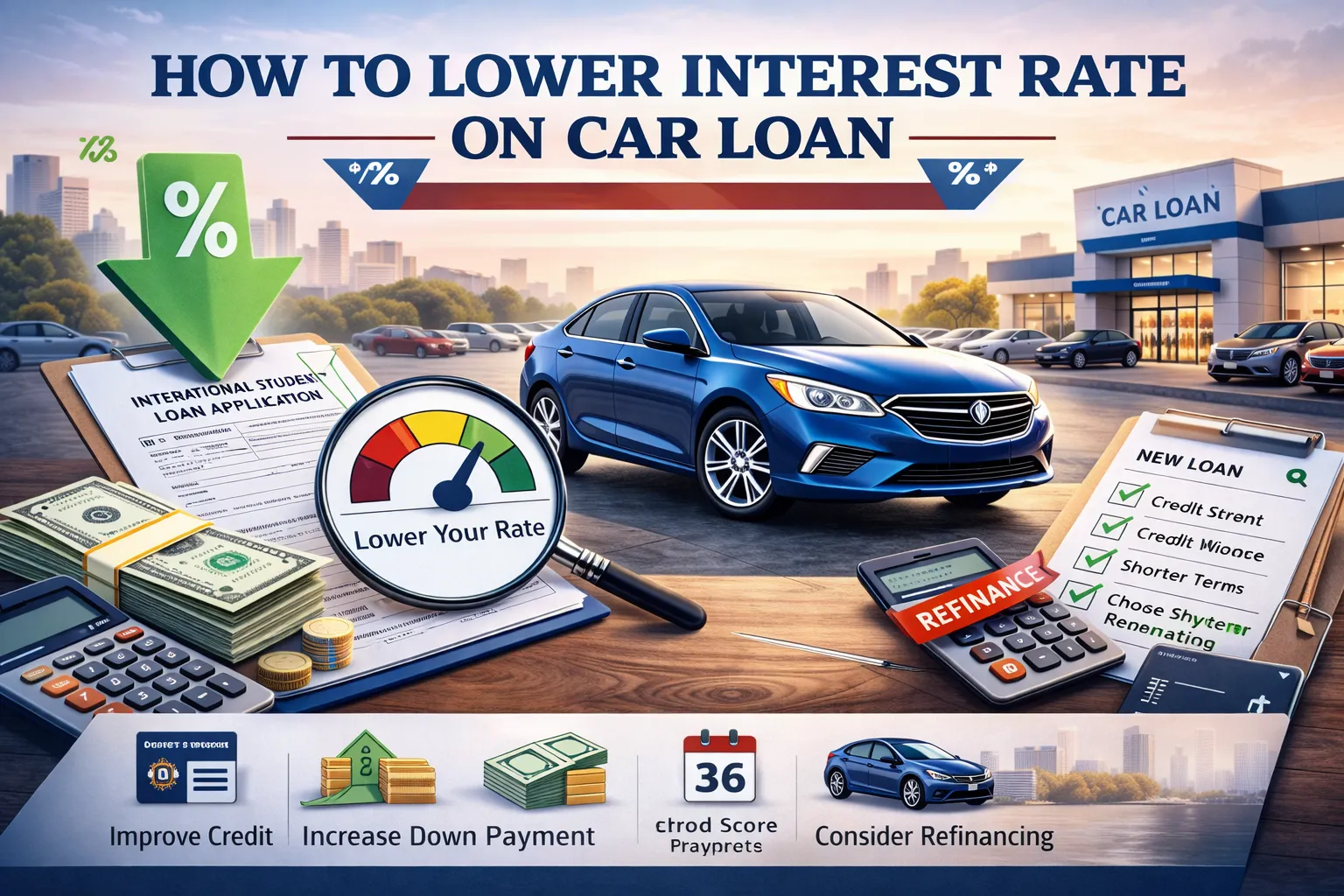
Lowering the interest rate on a car loan directly reduces the total cost of borrowing and improves payment efficiency over the life of the loan. Interest rates are determined through risk based pricing models that evaluate borrower creditworthiness loan structure and collateral quality. Adjusting these variables can materially impact the rate offered by a lender or the rate achieved through refinancing.
How Auto Loan Interest Rates Are Determined
Auto lenders apply underwriting models that assign a risk tier to each borrower. This tier influences the annual percentage rate and loan terms.
Key variables include:
- Credit score and payment history
- Debt to income ratio
- Loan to value ratio
- Loan term length
- Vehicle age and mileage
- Income stability
Higher risk profiles are typically assigned higher interest rates to compensate for default probability.
Improve Credit Profile Before Applying
Credit score is a primary determinant of auto loan pricing. Incremental improvements can lead to measurable reductions in interest rates.
Payment History Optimization
On time payments across all credit accounts contribute significantly to score calculations. Delinquent accounts should be brought current prior to applying for a loan.
Credit Utilization Reduction
Credit utilization is calculated as revolving balances divided by total credit limits. Lower utilization ratios improve credit scoring outcomes.
A common benchmark is maintaining utilization below 30 percent.
Dispute and Correction of Errors
Incorrect negative entries can inflate risk assessments. Reviewing credit reports and disputing inaccuracies can improve scoring models used by lenders.
Increase Down Payment
A larger down payment reduces the loan amount and lowers the loan to value ratio.Loan to value ratio equals loan amount divided by vehicle value.
Lower loan to value ratios decrease lender risk and can qualify borrowers for better rates. It also reduces the probability of negative equity during the loan term.
Choose a Shorter Loan Term
- Loan term length affects both monthly payment and total interest cost.
- Shorter terms such as 36 or 48 months typically carry lower interest rates than longer terms like 72 or 84 months.
Although shorter terms increase monthly payments they reduce total interest expense and may qualify for preferential pricing tiers.
Select the Right Vehicle
Vehicle characteristics influence collateral risk.
Newer vehicles with lower mileage and higher resale value typically qualify for lower interest rates. Older vehicles increase depreciation risk which may lead to higher rates.
Some lenders impose rate adjustments for vehicles beyond certain age or mileage thresholds.
Compare Lenders
Interest rates vary across financial institutions due to different risk models and funding costs.
Common lender categories include:
- Banks
- Credit unions
- Captive finance companies
- Online auto lenders
Obtaining multiple loan estimates allows comparison of annual percentage rates loan terms and fees.
Preapproval can provide a benchmark rate before negotiating at a dealership.
Refinance an Existing Auto Loan
Refinancing replaces the current loan with a new loan at a lower interest rate.
When Refinancing Is Effective
Refinancing is typically beneficial when:
Credit score has improved since origination
Market interest rates have declined
Payment history is consistent
Vehicle retains sufficient value
Cost Analysis
Evaluate whether refinancing reduces total interest cost after accounting for any fees.
Remaining balance multiplied by new interest rate determines the revised cost structure. Lower rates combined with remaining term adjustments can reduce lifetime interest.
Add a Co Borrower
A co borrower with strong credit can improve the overall risk profile of the loan application.
Lenders evaluate the combined financial strength including credit scores income and debt obligations.
This may result in a lower interest rate or improved approval terms.
Reduce Debt to Income Ratio
Debt to income ratio equals total monthly debt payments divided by gross monthly income.
Lower ratios indicate stronger repayment capacity.
Reducing existing debt obligations before applying for a loan can improve rate eligibility.
Negotiate Dealer Financing Terms
Dealerships often arrange financing through third party lenders.
The interest rate presented may include a markup above the lender’s base rate. Negotiating financing terms can reduce this markup.
Requesting the buy rate from the lender can provide transparency in pricing structure.
Understand Interest Calculation Mechanics
Most auto loans use simple interest structures.
Daily interest accrues based on remaining principal using the formula:
daily interest equals principal multiplied by annual interest rate divided by 365
Payments are applied first to accrued interest and then to principal. Early payments or additional principal payments reduce the balance and decrease total interest.
Make Additional Principal Payments
Extra payments applied directly to principal reduce the outstanding loan balance.
This decreases future interest accrual because interest is calculated on a lower principal amount.
Confirm that additional payments are applied to principal and not treated as advance payments for future installments.
Avoid Extended Loan Terms
Extended terms increase total interest paid even if the monthly payment is lower.
For example a loan extended from 60 months to 84 months results in more interest accrual due to longer repayment duration.
Evaluating total of payments rather than monthly payment alone provides a more accurate cost comparison.
Maintain Continuous Insurance Coverage
Lenders require full coverage insurance.
Insurance lapses can trigger force placed insurance which increases monthly cost and may affect loan performance metrics.
Stable insurance coverage supports consistent loan servicing and avoids additional charges.
Timing and Market Conditions
Interest rates are influenced by broader economic conditions including benchmark rates and lender funding costs.
Applying during periods of lower benchmark rates can improve loan pricing.
Monitoring rate trends may provide opportunities to refinance or secure better terms.
Common Constraints That Limit Rate Reduction
Some borrowers may face structural limitations such as:
- Low or limited credit history
- High loan to value ratio
- Recent delinquencies
- Unstable income
In these cases lenders may not offer substantial rate reductions until risk factors improve.
Practical Evaluation Framework
Before accepting or modifying a loan evaluate:
- Annual percentage rate
- Loan term length
- Total interest cost
- Monthly payment affordability
- Prepayment flexibility
Comparing these variables provides a comprehensive view of borrowing cost rather than focusing on a single metric.
Structural Outcome
Lowering an auto loan interest rate requires a combination of improved borrower profile optimized loan structure and strategic timing. Adjustments such as increasing down payment shortening term length or refinancing after credit improvement directly influence rate outcomes.
Interest rate reduction is not a single step but a series of measurable changes that reduce lender risk and improve loan pricing over time.