
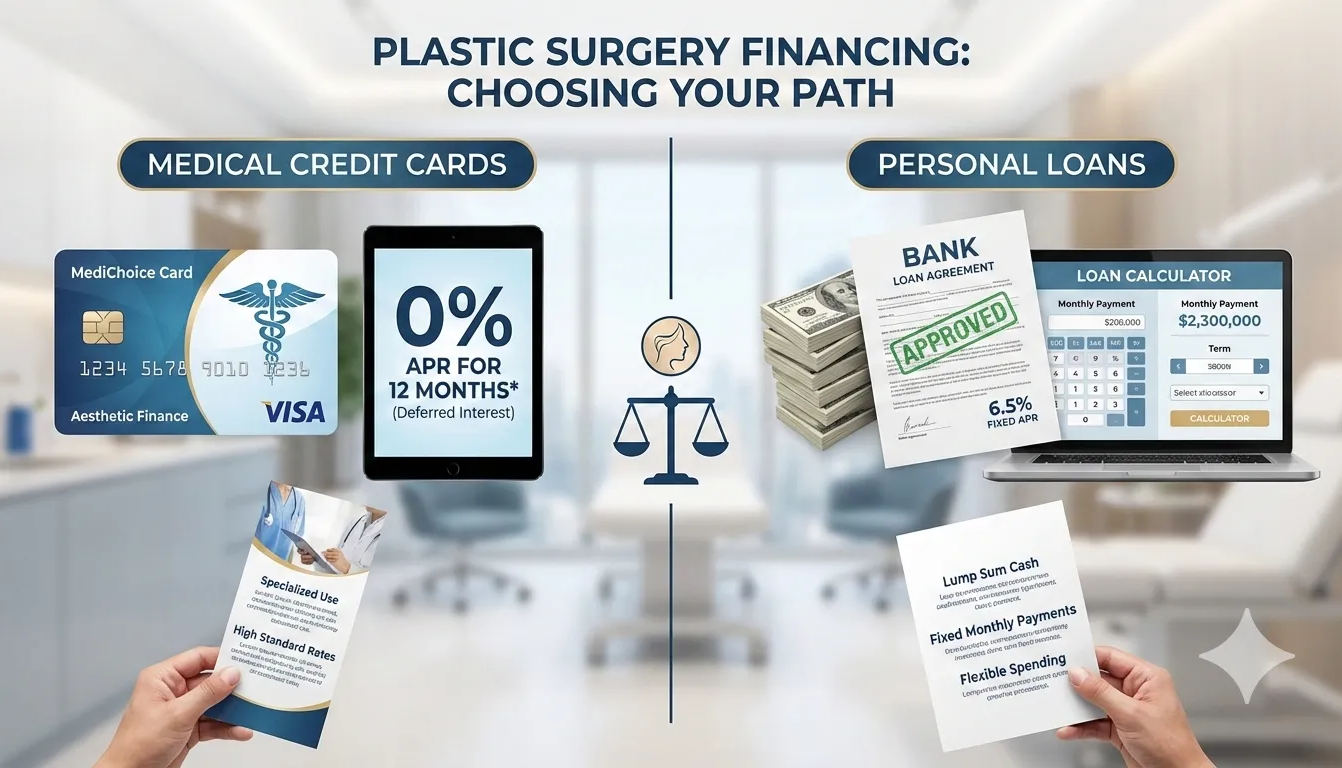
Deciding to undergo an aesthetic procedure is a deeply personal and exciting journey. However, once you have chosen your board-certified surgeon and finalized your treatment plan, you are immediately faced with the financial reality of the process. Because most cosmetic enhancements are considered elective, traditional health insurance policies rarely cover the expenses. This leaves patients responsible for covering the entire bill out of pocket. If you do not have the liquid cash readily available, you are likely looking into cosmetic surgery financing. Two of the most popular ways to fund these procedures are specialized healthcare cards and traditional unsecured borrowing. Choosing between medical credit vs personal loans for plastic surgery can significantly impact your long-term financial health, your monthly budget, and the total amount you ultimately pay for your procedure.
Understanding Plastic Surgery Financing Options
Before diving into the specific mechanisms of borrowing money for cosmetic surgery, it is crucial to understand why these specialized financial products exist. Procedures like rhinoplasty, breast augmentation, facelifts, and liposuction can cost anywhere from a few thousand dollars to tens of thousands of dollars. These are major financial investments. When patients cannot pay the lump sum upfront, lenders step in to bridge the gap.
Financing aesthetic procedures is a booming industry. The primary goal of any surgery payment plan is to break down a massive upfront cost into manageable monthly payments. However, not all borrowing methods are created equal. The route you choose will dictate your interest rates, your repayment timeline, and the level of flexibility you have with your funds. The debate between medical credit vs personal loans for plastic surgery usually comes down to the specific cost of your procedure, your current credit score, and how quickly you can realistically pay off the debt.
What Are Medical Credit Cards?
Medical credit cards are specialized revolving credit lines designed exclusively for healthcare expenses. The most well-known example in this category is CareCredit, though others like ALPHAEON Credit are also widely accepted by medical providers. Unlike your standard everyday rewards card, a medical credit card cannot be used to buy groceries or book a flight. It is strictly ring-fenced for out-of-pocket medical, dental, veterinary, and cosmetic expenses at enrolled and participating provider offices.
When you apply for a medical credit card for surgery, the issuing financial institution evaluates your creditworthiness and assigns you a maximum credit limit. You can then use this card to pay your plastic surgeon directly. As you pay down your balance, that credit becomes available to use again for future medical expenses.
The biggest draw of these cards is their promotional financing periods. Many medical credit cards offer promotional terms of six, twelve, eighteen, or even twenty-four months with zero percent annual percentage rate (APR). This means if you borrow $6,000 for a procedure and pay it off completely within the specified promotional window, you will not pay a single penny in interest.
Pros and Cons of Medical Credit Cards for Cosmetic Procedures
To make an informed decision, you must weigh the specific advantages and drawbacks of utilizing a healthcare-specific credit line.
Pros of Medical Credit Cards:
- Zero Percent Promotional Financing: This is the undisputed champion feature. If you have a solid repayment strategy and can aggressively pay down the balance before the promotional period ends, this is effectively a free loan.
- Revolving Credit Line: Once approved, you can use the card for multiple treatments over time. If you plan to have a staged procedure or want to finance non-surgical maintenance treatments like Botox or dermal fillers later on, the credit line remains open and available.
- Fast Approval Process: You can often apply for these cards directly in your plastic surgeon’s waiting room and receive an approval decision within minutes, allowing you to schedule your surgery immediately.
- Soft Credit Check Pre-Qualification: Many issuers now offer a pre-qualification process that utilizes a soft credit pull, allowing you to see your odds of approval without damaging your credit score.
Cons of Medical Credit Cards:
- Deferred Interest Traps: This is the most significant risk. The zero percent promotional rate is usually “deferred interest.” If you miss a single monthly payment or fail to pay off the entire balance by the end of the promotional term, the lender will retroactively apply interest to the original total loan amount from the very first day.
- Exorbitant Standard Interest Rates: Once the promotional period expires, the standard APR on medical credit cards is notoriously high, often hovering near thirty percent.
- Limited Usability: You can only use the card at medical facilities that specifically accept that exact brand of card. You cannot use the funds to cover indirect surgical costs like recovery hotel stays, specialized post-op garments, or meal delivery services.
- Impact on Credit Utilization: Maxing out a medical credit card to pay for a costly surgery will drastically increase your credit utilization ratio, which can severely and temporarily lower your overall credit score.
What Are Personal Loans for Plastic Surgery?
Personal loans for cosmetic procedures operate entirely differently from revolving credit lines. A personal loan is an unsecured installment loan provided by a traditional bank, a credit union, or an online direct lender. “Unsecured” means you do not need to put up collateral, such as your home or your vehicle, to guarantee the loan.
When you are approved for a personal loan, the lender deposits a single lump sum of cash directly into your personal bank account. You then use that cash to pay your plastic surgeon. Afterward, you repay the lender in fixed, equal monthly installments over a predetermined period, which typically ranges from twelve to eighty-four months.
Unlike medical credit cards, personal loans for plastic surgery are not tied to a specific healthcare provider. The cash is yours to manage. Because these plastic surgery loans feature a fixed interest rate, your monthly payment will never change throughout the life of the loan, providing absolute predictability for your monthly household budget.
Pros and Cons of Personal Loans for Aesthetic Surgery
Understanding the mechanics of unsecured medical loans is vital for long-term financial planning. Here is a detailed breakdown of their strengths and weaknesses.
Pros of Personal Loans:
- Ultimate Flexibility: Because the funds are deposited directly into your checking account, you have complete control over the money. You can pay your surgeon, but you can also use the leftover funds to buy prescription pain medication, hire a temporary nurse, or cover your rent while you take unpaid time off work to recover.
- Fixed Predictable Payments: Personal loans lock in your interest rate and your repayment term from day one. You will know exactly how much you owe every single month and the exact date you will be entirely debt-free.
- No Deferred Interest Penalties: With a standard installment loan, there are no deferred interest traps. You simply pay the agreed-upon interest rate over the life of the loan.
- Larger Borrowing Limits: If you are undergoing a highly complex or combined procedure like a “mommy makeover,” personal loans typically offer much higher borrowing limits than medical credit cards, sometimes up to $50,000 or even $100,000 for highly qualified borrowers.
Cons of Personal Loans:
- Interest Accrues Immediately: Unlike the promotional periods found on medical credit cards, personal loans almost never offer zero percent APR options. You will begin paying interest from the very first month.
- Strict Eligibility Requirements: Securing a favorable interest rate on an unsecured personal loan requires a strong credit history, a low debt-to-income ratio, and verifiable proof of steady income.
- Origination Fees: Many online lenders charge an origination fee, which is an administrative cost deducted from your total loan amount before the funds are deposited into your account.
- Hard Credit Inquiry: Applying for a personal loan will almost always result in a hard inquiry on your credit report, which can cause a slight, temporary dip in your credit score.
Medical Credit vs Personal Loans: Key Differences Compared
To determine the absolute best way to pay for plastic surgery, you must pit these two financial products directly against one another across several critical categories.
1. Interest Rate Structures
Medical credit cards heavily rely on the allure of zero percent promotional APRs. If you are disciplined, this is the cheapest way to borrow money. However, if you slip up, the retroactive interest can be devastating. Personal loans offer a more straightforward, honest structure. You will be assigned a fixed APR based on your creditworthiness, which usually ranges from 6% to 36%. While you pay interest from day one, you are protected from sudden rate spikes.
2. Repayment Timelines
Healthcare credit cards are designed for short-to-medium-term repayment. The promotional periods rarely extend beyond twenty-four months. If you need more time to pay off a $15,000 surgery, a medical credit card will eventually force you into their high standard APR. Personal loans, conversely, are built for the long haul. You can stretch your payments over five or even seven years, which drastically lowers your monthly out-of-pocket obligation, though it increases the total amount of interest paid over time.
3. The Scope of Financing
When you use a product like CareCredit for plastic surgery, the financial transaction occurs directly between the lender and the medical provider’s billing department. The scope is strictly limited to the surgical invoice. Personal loans provide you with liquid cash. This means you can negotiate cash discounts with your surgeon, pay for travel if you are flying out of state for a specific specialist, and handle all the hidden ancillary costs of surgical recovery.
4. Credit Score Requirements
Medical credit card issuers are sometimes slightly more forgiving of average credit scores because the cards have lower limits and are restricted to medical uses. Getting approved for a massive unsecured personal loan with a competitive rate requires a good to excellent credit score. If your credit is poor, you might be denied a personal loan entirely or offered an APR so high that the loan becomes unaffordable.
How Your Credit Score Impacts Your Financing Strategy
Your credit profile is the single most important factor when navigating cosmetic surgery financing. Lenders view unsecured borrowing as a high-risk endeavor because there is no physical property they can repossess if you default on your payments. Therefore, your credit history acts as their only assurance.
Before applying for either a medical credit card or a personal loan, you must pull your credit reports from the major bureaus. Look for any errors, outstanding collections, or high credit card balances that you can pay down to boost your score rapidly.
If you have excellent credit (a FICO score above 740), you are in the driver’s seat. You will easily qualify for the longest zero percent promotional periods on medical credit cards, and you will unlock the lowest possible fixed APRs from personal loan providers. In this scenario, your choice simply depends on whether you want to pay the debt off aggressively or stretch it out.
If you have fair or average credit (a score between 580 and 669), your options narrow. A medical credit card might approve you, but perhaps only for a $2,000 limit, which will not cover a major surgery. A personal loan lender might approve you, but slap you with a twenty-five percent APR. In these situations, it is highly advisable to delay the procedure, focus on repairing your credit profile, and save up a larger cash down payment to reduce the amount you need to borrow.
Hidden Costs and Fees to Watch Out For
When comparing medical credit vs personal loans for plastic surgery, the interest rate is not the only number you need to scrutinize. Both avenues contain hidden fees that can inflate the cost of your procedure.
For personal loans, the most common hidden cost is the origination fee. This fee usually ranges from 1% to 8% of the total loan amount. If you borrow $10,000 with a 5% origination fee, the lender will keep $500, and you will only receive $9,500 in your bank account, leaving you short on your surgeon’s bill. Always ask lenders if they charge origination fees and calculate them into your total required loan amount. Additionally, check for prepayment penalties. Some lenders charge you a fee if you pay your loan off early because they miss out on the anticipated interest revenue.
For medical credit cards, the hidden costs are mostly behavioral. The deferred retroactive interest is the primary trap. Furthermore, some medical providers charge a “convenience fee” or a surcharge if you pay with a credit card instead of cash or a cashier’s check to cover the merchant processing fees they incur.
Step-by-Step Guide: How to Choose the Right Financing for Your Procedure
Making the final decision requires a methodical approach to ensure you are protecting your financial well-being while achieving your aesthetic goals.
Step 1: Obtain a Comprehensive Surgical Quote
Do not guess how much your surgery will cost. Have a formal consultation with your plastic surgeon and request a fully itemized quote. This quote must include the surgeon’s fee, the anesthesiologist’s fee, the operating room facility fee, and the cost of any implants or garments.
Step 2: Calculate Your Ancillary Recovery Costs
Add up the expenses the surgeon’s quote does not cover. This includes prescription medications, time off work, childcare during your recovery, and travel logistics. This total number is your actual financing target.
Step 3: Assess Your Monthly Cash Flow
Look at your household budget. Determine the absolute maximum amount of money you can afford to part with every month to service this new debt without causing financial distress.
Step 4: Run the Promotional Math
If you are considering a medical credit card, divide your total surgical cost by the number of months in the promotional period. If your surgery is $12,000 and the promo period is 12 months, you must pay $1,000 every single month to avoid interest. If that monthly payment exceeds your cash flow from Step 3, a medical credit card is the wrong choice for you.
Step 5: Shop for Personal Loan Rates
Use online lending marketplaces to pre-qualify for personal loans using soft credit checks. Compare the fixed APRs and monthly payment terms offered by various lenders. Choose the term that perfectly aligns with your comfortable monthly cash flow.
Alternative Cosmetic Surgery Financing Methods
While medical credit vs personal loans for plastic surgery dominate the conversation, there are a few other methods you might consider to fund your aesthetic journey.
In-House Surgeon Payment Plans
Some large, high-volume plastic surgery clinics act as their own lenders. They will allow you to make a substantial down payment and then pay the remainder of the balance directly to the clinic over a few months. These plans often feature no interest and do not require formal credit checks, but the repayment windows are usually extremely short.
Standard Zero Percent APR Credit Cards
If you have excellent credit, you might simply apply for a standard, non-medical rewards credit card that offers a fifteen or eighteen-month zero percent introductory APR on all new purchases. This functions similarly to a medical credit card but often allows you to earn valuable sign-up bonuses or travel miles on the massive surgical purchase.
Home Equity Financing
Homeowners with significant equity might tap into a Home Equity Line of Credit (HELOC) or a home equity loan to pay for surgery. Because these loans are secured by your house, the interest rates are incredibly low. The massive risk, however, is that if you default on the payments, the bank can foreclose on your home.
Final Checklist Before You Apply
Securing funding is the last major hurdle before your operation. Ensure you have the following documentation and information prepared before you submit any formal applications for plastic surgery loans or credit lines:
- A copy of your government-issued identification.
- Your most recent pay stubs or W-2 forms to prove your steady income.
- Your exact target loan amount, accounting for all origination fees.
- A clear understanding of your current FICO credit score.
- The exact date your surgeon requires the final payment.