
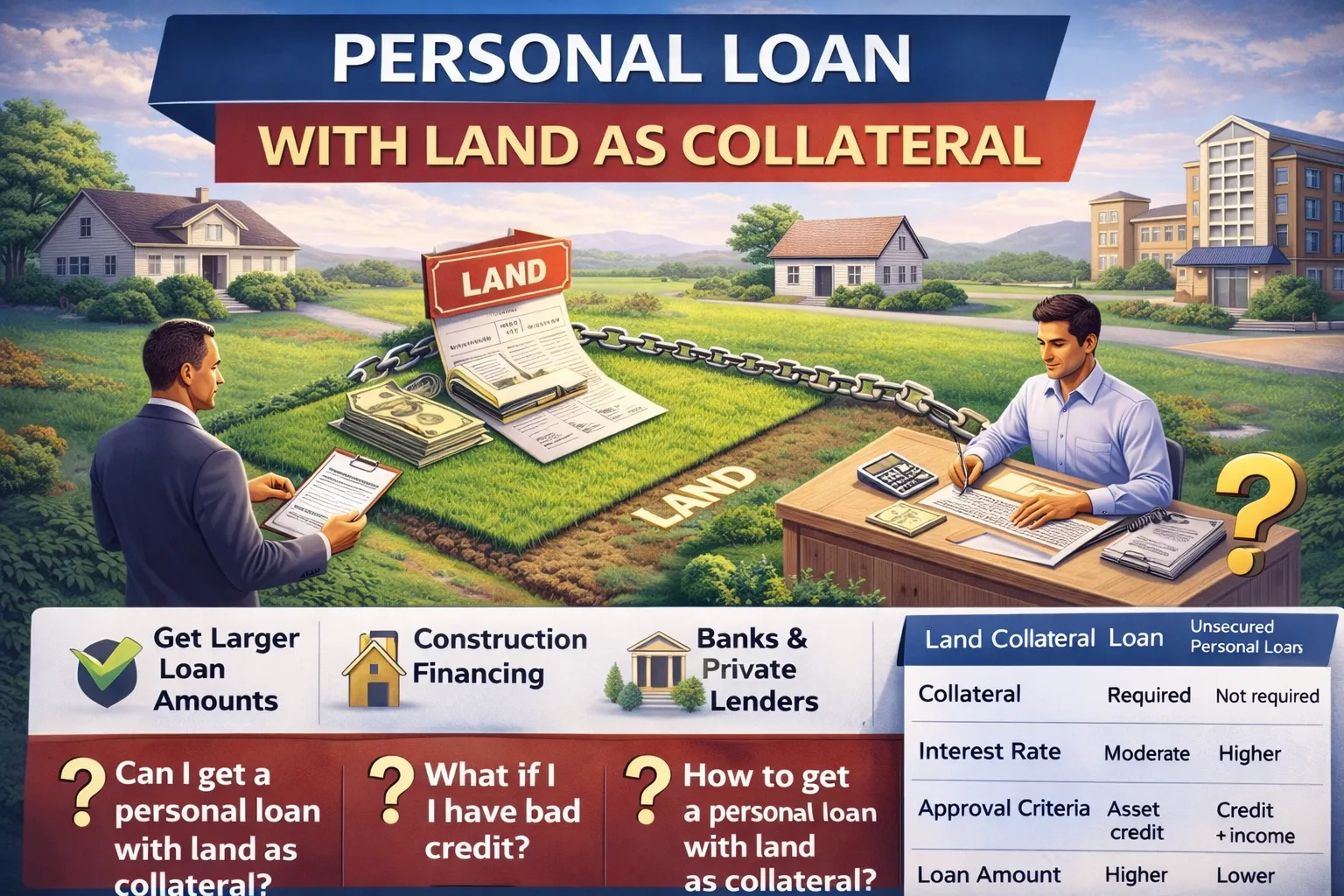
A personal loan with land as collateral is a secured financing structure in which a borrower pledges real property ownership rights to obtain credit. Unlike unsecured personal loans that rely primarily on credit scores and income verification, land-backed lending introduces asset-based underwriting, where collateral value, title condition, and lien position become central risk determinants.
This structure is commonly referred to as a loan against land or land collateral loan. It is frequently used when borrowers require larger principal amounts, longer repayment horizons, or more flexible underwriting compared to unsecured credit products.
What Is a Personal Loan With Land as Collateral
A personal loan with land as collateral is a secured loan where:
- The borrower pledges vacant land, residential land, or agricultural land
- The lender places a lien on the property title
- The loan amount is determined by loan-to-value ratio (LTV)
- Failure to repay can result in foreclosure or forced sale of the land
Unlike traditional mortgage loans that are used specifically for property purchase, these loans are typically multi-purpose. Borrowers may use funds for debt consolidation, business expenses, construction, or personal financial needs.
How Land Collateral Loans Work
Collateral Valuation and Loan-to-Value Ratio
Lenders determine loan eligibility based on the appraised value of the land. The loan-to-value ratio defines how much can be borrowed relative to that value.
Typical structure:
- Loan Amount = Land Value × LTV Percentage
For example: If land is valued at 100,000 dollars and the lender offers a 50 percent LTV, the maximum loan amount would be 50,000 dollars.
LTV ratios for land are typically lower than for residential properties because land is considered a higher-risk asset with lower liquidity.
Title Verification and Lien Placement
The lender performs a title search to ensure:
- Clear ownership
- No existing liens or encumbrances
- Legal usability of the land
Once approved:
- A lien is recorded against the property
- The lender becomes a secured creditor
- The lien remains until the loan is repaid in full
Interest Rates and Risk-Based Pricing
Interest rates on land-backed personal loans are influenced by:
- Credit profile of the borrower
- Type and location of land
- LTV ratio
- Loan term length
Because land is less liquid than residential property, interest rates are generally higher than mortgage rates but lower than unsecured personal loans.
Types of Loans Using Land as Collateral
Loan Against Land
This is the most direct structure where land is pledged to obtain funds without a specified use restriction. Borrowers retain ownership but grant the lender a security interest.
Using Land as Collateral for Construction Loan
In this structure:
- Land serves as initial collateral
- Loan funds are disbursed in stages (draw schedule)
- Funds are used specifically for building construction
This differs from standard land loans because disbursement depends on construction milestones.
Using House as Collateral for a Loan
Although distinct from vacant land loans, this category involves:
- Existing residential property
- Higher LTV ratios
- Lower interest rates due to improved collateral quality
This structure is often referred to as a home equity loan or second mortgage.
Can You Get a Personal Loan With Land as Collateral
Yes, but approval depends on multiple underwriting factors:
Key Approval Criteria
- Verified land ownership
- Acceptable land classification (residential preferred over agricultural in many jurisdictions)
- Clear title with no disputes
- Minimum credit profile thresholds (varies by lender)
- Stable income or repayment capacity
Borrowers frequently ask: can I get a personal loan with land as collateral if I have limited credit history. The answer depends on the lender’s reliance on collateral versus creditworthiness. Some asset-based lenders place more weight on land value than credit score.
Personal Loan With Land as Collateral for Bad Credit
Borrowers with low credit scores may still qualify under secured lending structures because:
- Collateral reduces lender risk exposure
- Recovery is possible through asset liquidation
However, this does not eliminate risk-based pricing adjustments.
Typical Adjustments for Bad Credit Borrowers
- Lower LTV ratios
- Higher interest rates
- Shorter loan terms
- Additional documentation requirements
The presence of collateral does not fully offset credit risk but can expand eligibility compared to unsecured loans.
Personal Loan With Land as Collateral No Credit Check
Loans advertised as no credit check typically fall into alternative lending categories. In practice:
- Most regulated lenders still perform at least a soft credit review
- Some private lenders prioritize asset valuation over credit scoring
Borrowers should distinguish between:
- No hard inquiry loans
- Minimal credit reliance loans
- True no credit underwriting (less common and higher risk)
These loans often carry elevated interest rates and stricter repayment terms.
Lenders That Accept Land as Collateral
Lenders offering land-backed loans typically include:
Banks
- More conservative underwriting
- Lower LTV ratios
- Strong documentation requirements
Credit Unions
- Member-based lending
- Competitive rates for qualified borrowers
- Flexible underwriting in some cases
Private and Hard Money Lenders
- Faster approvals
- Higher interest rates
- Greater tolerance for credit risk
- Strong emphasis on collateral value
Online Lenders
- Streamlined application processes
- Mixed underwriting models
- Varying acceptance of land as collateral
How to Get a Personal Loan With Land as Collateral
Step 1: Determine Land Value
Obtain a professional appraisal or comparative market valuation. This establishes the baseline for LTV calculations.
Step 2: Verify Title Status
Ensure:
- Title is clear
- Property is properly registered
- No legal disputes exist
Title defects can delay or disqualify loan approval.
Step 3: Evaluate Loan Terms
Compare:
- Interest rates
- Loan duration
- Repayment structure
- Fees and closing costs
Step 4: Submit Application
Provide:
- Proof of ownership
- Income documentation
- Identification records
- Land details and location data
Step 5: Underwriting and Approval
The lender evaluates:
- Collateral value
- Borrower repayment capacity
- Risk exposure
Upon approval, loan documents are executed and lien is recorded.
Interest Calculation and Amortization
Amortization Structure
Most land-backed personal loans follow an amortization schedule where:
- Each payment includes principal and interest
- Early payments are interest-heavy
- Later payments shift toward principal reduction
Simple Interest Formula
Interest is commonly calculated using:
Interest = Principal × Rate × Time
Where:
- Principal is the loan amount
- Rate is the annual interest rate
- Time is expressed in years
Per Diem Interest
Per diem interest refers to daily interest accrual calculated as:
Per diem interest = Loan balance × annual rate ÷ 365
This becomes relevant during:
- Loan payoff
- Refinancing
- Early settlement
Risks of Using Land as Collateral
Foreclosure Risk
Failure to meet repayment obligations can result in:
- Legal foreclosure proceedings
- Loss of land ownership
- Forced asset sale
Lower Liquidity of Land
Land is less liquid than residential property, meaning:
- Longer sale timelines
- Potential valuation discounts
- Higher lender risk premiums
Title and Zoning Restrictions
Land usability affects lending decisions:
- Agricultural vs residential classification
- Zoning compliance
- Access to utilities and infrastructure
Advantages of Land Collateral Loans
- Access to higher loan amounts
- Potentially lower rates than unsecured loans
- Flexible use of funds
- Expanded eligibility for borrowers with limited credit history
Common Use Cases
Borrowers typically use land-backed loans for:
- Construction financing
- Debt consolidation
- Business investment
- Emergency liquidity
- Property development
Difference Between Land Loans and Personal Loans
Feature Land Collateral Loan Unsecured Personal Loan Collateral Required Not required Interest Rate Moderate Higher Approval Criteria Asset + credit Credit + income Risk to Borrower Asset loss Credit damage Loan Amount Higher Lower
Regulatory and Legal Considerations
Land-backed lending is subject to:
- State-level property laws
- Recording requirements for liens
- Foreclosure procedures
- Consumer protection regulations
Borrowers must review:
- Loan agreements
- Default clauses
- Prepayment penalties
Key Considerations Before Applying
- Confirm accurate land valuation
- Assess repayment capacity
- Understand foreclosure implications
- Review total borrowing cost including fees
- Verify lender legitimacy and regulatory compliance
Practical Interpretation of Borrower Questions
Can I get a personal loan with land as collateral
Yes, provided the land meets lender criteria and the borrower demonstrates repayment ability.
How to get a personal loan with land as collateral
The process involves valuation, title verification, application submission, underwriting, and lien placement.
Personal loans with land as collateral for low credit profiles
Possible through secured lending, but typically involves higher costs and stricter terms.
Using land as collateral for construction loan
Common structure where land serves as initial equity, and funds are released progressively based on construction milestones.
Closing Technical Perspective
Land-backed personal loans operate at the intersection of consumer lending and real estate finance. The primary differentiator is collateral dependency, which shifts risk analysis from borrower-centric metrics to asset-based evaluation. Lenders balance creditworthiness, land valuation, and market liquidity when structuring these loans, while borrowers assume the critical obligation of protecting the pledged asset through consistent repayment.