
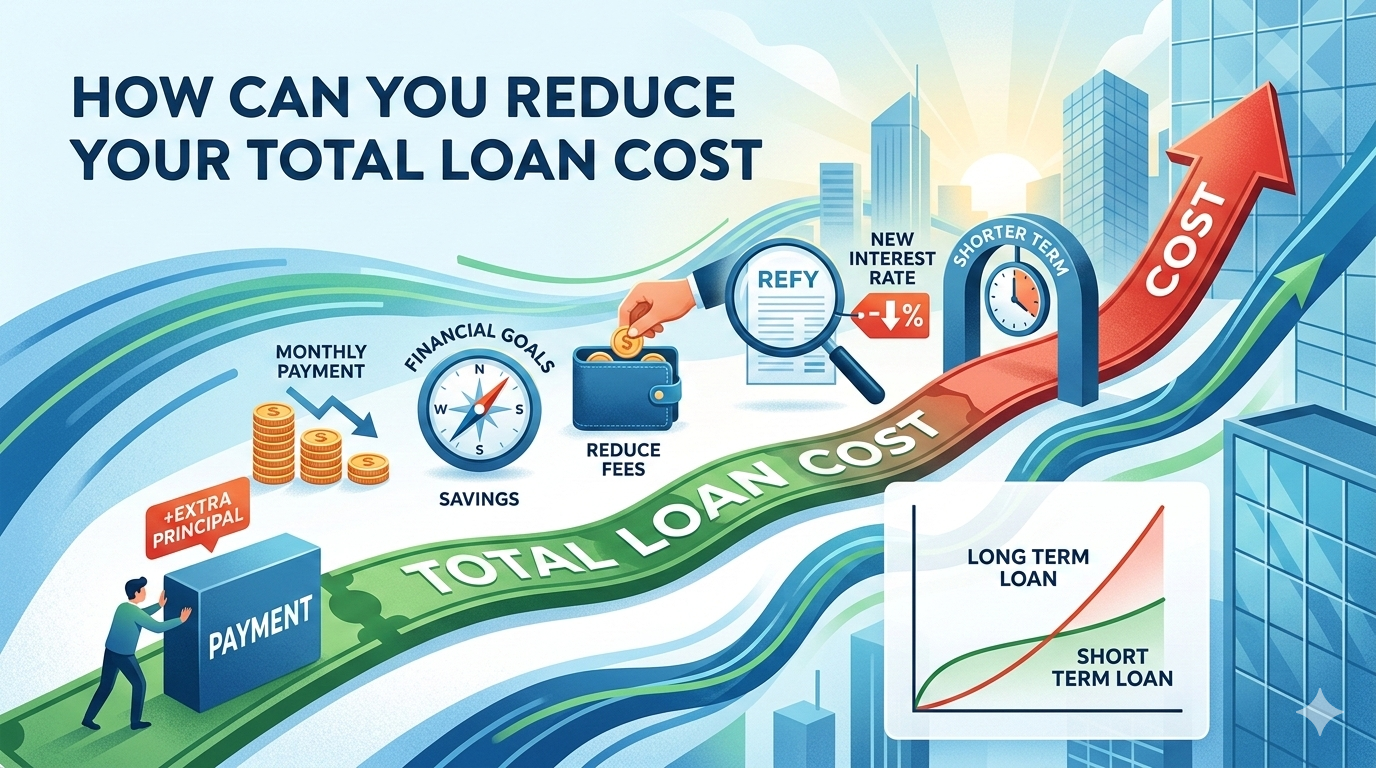
Reducing the total cost of a loan requires more than focusing on the monthly payment. The total cost includes interest charges, fees, and the time value of money across the full repayment period. Borrowers who understand amortization, interest accrual, and repayment structure can significantly lower the amount paid over the life of a loan.
This article explains how to reduce your total loan cost using structured financial methods, including interest reduction strategies, principal prepayment, loan term optimization, and refinancing mechanics.
Understanding Total Loan Cost
The total loan cost is the sum of all payments made over the life of a loan. This includes:
- Principal amount borrowed
- Total interest paid
- Fees such as origination or prepayment penalties
Formula Explanation
Total loan cost can be expressed as:
Total cost equals principal plus total interest plus fees
Reducing any one of these components lowers the overall financial burden.
How Interest Accrual Impacts Loan Cost
Interest is the largest component of total loan cost.
Simple Interest vs Amortized Interest
- Simple interest is calculated only on the principal
- Amortized loans calculate interest on the remaining balance
In amortized loans, early payments are heavily weighted toward interest. This structure increases total cost if the loan is carried for the full term.
Loan Term and Its Effect on Total Cost
The loan term directly influences how much interest accrues.
Short Term vs Long Term
- Shorter term → higher monthly payments but lower total interest
- Longer term → lower monthly payments but higher total interest
Example
A five-year loan will typically cost less in total interest than a seven-year loan for the same principal and interest rate.
Making Extra Payments Toward Principal
One of the most effective ways to reduce total loan cost is to make additional payments toward the principal.
How It Works
Extra payments reduce the outstanding balance faster, which lowers future interest charges.
Impact
- Reduces loan term
- Decreases total interest paid
- Improves amortization efficiency
Even small additional payments applied consistently can result in measurable savings.
Biweekly Payment Strategy
Instead of making one monthly payment, borrowers can split payments into biweekly installments.
Mechanism
- 26 half-payments per year equal 13 full payments
- One extra payment annually reduces principal faster
Result
- Shorter loan duration
- Lower total interest cost
Refinancing to Lower Interest Rate
Refinancing replaces an existing loan with a new one, typically with better terms.
When Refinancing Reduces Cost
- Interest rates have decreased
- Credit score has improved
- Loan terms can be shortened
Cost Consideration
Refinancing may include fees, so savings must exceed these costs to be effective.
Improving Credit Score Before Borrowing
Credit score directly affects the interest rate offered by lenders.
Benefits of Higher Credit Score
- Lower interest rates
- Better loan terms
- Reduced total repayment amount
Even a small reduction in interest rate can significantly lower total loan cost over time.
Choosing the Right Loan Type
Different loan structures have different cost implications.
Fixed Rate Loans
- Stable interest rate
- Predictable payments
- Protection from rate increases
Variable Rate Loans
- Lower initial rates
- Risk of future increases
Borrowers should evaluate long-term cost exposure when selecting loan types.
Avoiding Unnecessary Fees
Fees increase the total cost without reducing principal.
Common Fees
- Origination fees
- Late payment fees
- Prepayment penalties
Minimizing or avoiding these fees directly reduces total cost.
Paying More Than the Minimum Payment
Minimum payments are structured to extend the loan term.
Strategy
Paying above the required amount reduces principal faster.
Result
- Less interest accrual
- Shorter repayment period
This is particularly effective for high-interest loans.
Understanding Per Diem Interest
Per diem interest refers to the daily interest charge on a loan.
Calculation
Daily interest equals outstanding principal multiplied by annual rate divided by 365
Importance
- Paying earlier in the billing cycle reduces daily interest accumulation
- Delayed payments increase total interest cost
Avoiding Loan Extensions and Deferrals
Loan extensions or payment deferrals increase total cost.
Why
- Interest continues to accrue
- Loan term is extended
These options should be used only when necessary.
Debt Consolidation and Its Impact
Debt consolidation combines multiple debts into one loan.
Potential Benefits
- Lower interest rate
- Simplified payments
Risk
If the new loan has a longer term, total cost may increase despite lower monthly payments.
Loan Amortization Optimization
Amortization schedules determine how payments are allocated.
Key Insight
- Early principal reduction has the highest impact
- Interest savings compound over time
Borrowers who target early principal reduction achieve the greatest cost savings.
Timing Your Payments Strategically
Payment timing affects interest accumulation.
Best Practice
- Pay early in the billing cycle
- Avoid last-day payments
This reduces daily interest charges and overall cost.
Avoiding High-Risk Loan Products
Certain loan types inherently increase total cost.
Examples
- Payday loans
- High-interest short-term loans
These products often carry significantly higher interest rates and fees.
Using Lump Sum Payments Effectively
Applying bonuses or unexpected income toward the loan principal can significantly reduce cost.
Impact
- Immediate reduction in outstanding balance
- Lower future interest accrual
This strategy is highly effective when applied early in the loan term.
Monitoring Loan Statements Regularly
Regular review helps identify:
- Incorrect interest charges
- Fee discrepancies
- Opportunities for early payoff
Active monitoring ensures cost control.
Aligning Loan Strategy With Financial Goals
Loan repayment strategy should align with broader financial planning.
Considerations
- Cash flow stability
- Emergency savings
- Investment opportunities
Balancing these factors ensures sustainable debt management.
Common Mistakes That Increase Loan Cost
- Choosing longer terms for lower payments
- Ignoring interest rate differences
- Making only minimum payments
- Missing payment deadlines
Avoiding these mistakes can significantly reduce total cost.
Practical Example of Cost Reduction
Scenario
Loan amount: 20,000
Interest rate: 8 percent
Term: 60 months
Adjustment
- Adding 100 extra monthly payment
Result
- Reduced loan term
- Lower total interest paid
Small adjustments can produce measurable savings.
Answering Common Questions
How Can You Reduce Your Total Loan Cost Quickly
By making extra principal payments and securing a lower interest rate.
Does Paying Early Reduce Interest
Yes, early payments reduce principal and lower future interest.
Is Refinancing Always Beneficial
Only if total savings exceed refinancing costs.
Does Loan Term Matter
Yes, longer terms increase total interest paid.
Structural Insight
Reducing total loan cost is primarily driven by controlling interest exposure and repayment duration. Strategies that accelerate principal reduction or lower the effective interest rate have the greatest impact. The timing of payments, loan structure, and borrower credit profile collectively determine the total financial outcome over the life of the loan.