
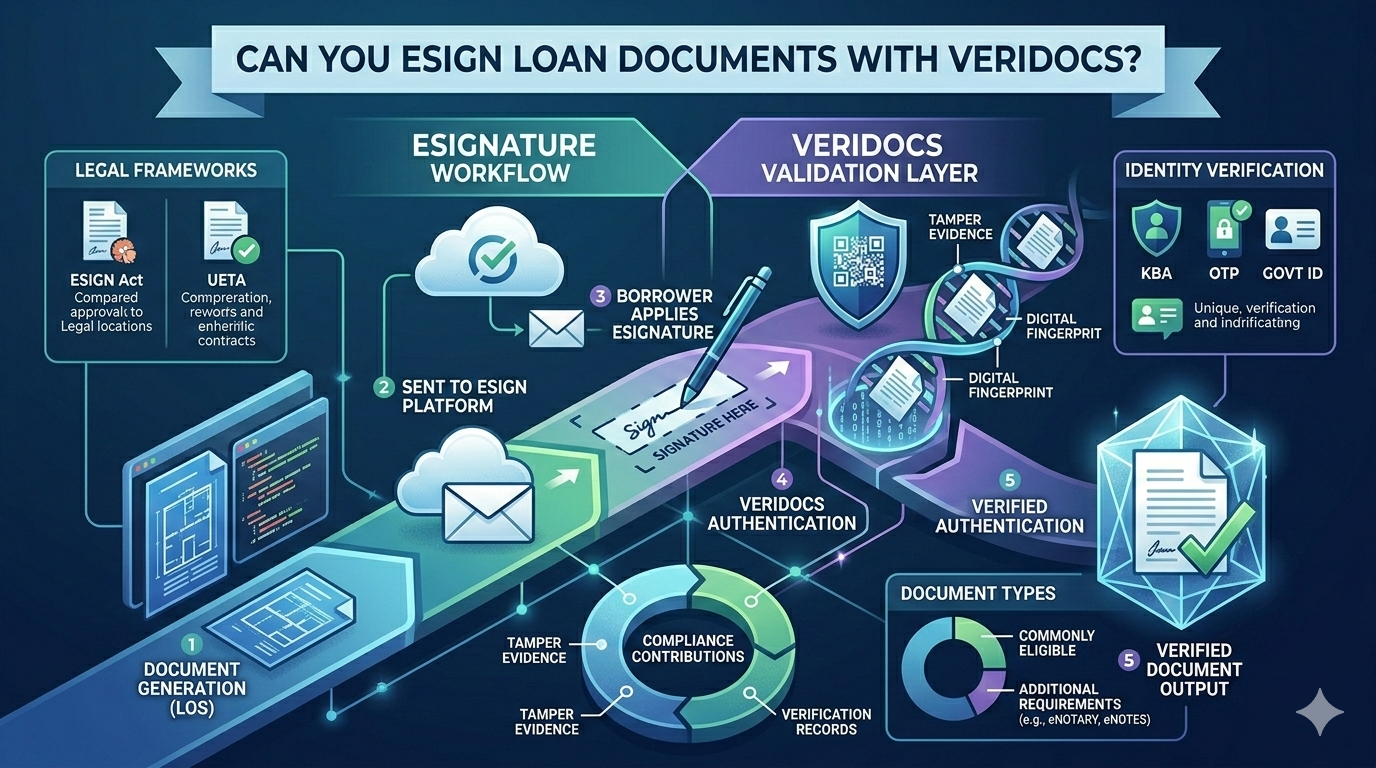
Electronic signatures have become a standard component of modern lending workflows, particularly in consumer, mortgage, and commercial loan origination systems. Borrowers increasingly expect remote closing capabilities, while lenders require compliant, auditable, and secure documentation processes. This raises a specific operational question: can loan documents be electronically signed using VeriDocs, and under what conditions does such usage remain legally enforceable in the United States?
This article examines how electronic signatures function in lending, the role of VeriDocs in document execution, and the compliance framework governing enforceability. It also addresses limitations, document types, identity verification controls, and audit requirements relevant to loan transactions.
What Is VeriDocs in Loan Document Processing
VeriDocs is a digital document authentication and verification platform designed to ensure document integrity, prevent tampering, and provide verifiable proof of authenticity. It is often used in conjunction with electronic signature workflows rather than as a standalone eSignature provider.
Core Functional Capabilities
- Document hashing and fingerprinting for tamper detection
- QR code or digital seal validation for document authenticity
- Integration with document management systems and loan origination software
- Verification portals for third-party validation of signed documents
VeriDocs does not function as a traditional eSignature platform in the same category as tools that directly capture borrower signatures. Instead, it complements electronic signing systems by validating finalized documents.
Can Loan Documents Be eSigned Using VeriDocs
Loan documents can be electronically signed in workflows where VeriDocs is integrated with an eSignature provider. However, VeriDocs itself is not typically the primary interface used by borrowers to sign documents.
Practical Workflow Structure
- Loan documents are generated through a loan origination system (LOS)
- Documents are sent to an eSignature platform for execution
- Borrowers apply electronic signatures
- Completed documents are processed through VeriDocs for authentication
- A digital fingerprint or verification layer is attached
This means VeriDocs supports the integrity and verification stage rather than the signature capture stage.
Legal Framework for eSigning Loan Documents
Electronic signatures in U.S. lending are governed by two primary legal frameworks:
ESIGN Act (Electronic Signatures in Global and National Commerce Act)
- Establishes that electronic signatures carry the same legal weight as handwritten signatures
- Requires borrower consent to receive electronic records
- Mandates clear disclosure of electronic record usage
UETA (Uniform Electronic Transactions Act)
- Adopted by most states
- Defines validity of electronic signatures and records
- Requires intent to sign and association of signature with the record
For a loan document signed electronically and verified through systems like VeriDocs to be enforceable, the process must satisfy both ESIGN and UETA requirements.
Types of Loan Documents That Can Be eSigned
Not all loan documents have the same execution requirements. The ability to eSign depends on regulatory acceptance and lender policy.
Commonly Eligible Documents
- Promissory notes (in many consumer loan contexts)
- Loan agreements
- Disclosure statements (Truth in Lending disclosures)
- Credit applications
- Authorization forms
Documents with Additional Requirements
- Mortgage notes (may require eNote standards under MISMO)
- Security instruments (often require notarization)
- Title-related documents (subject to state recording laws)
In mortgage lending, electronic notarization (eNotary) and remote online notarization (RON) may be required alongside eSignature tools.
Role of VeriDocs in Compliance and Audit Trails
While VeriDocs does not directly capture signatures, it plays a critical role in compliance by strengthening document authenticity and auditability.
Key Compliance Contributions
- Tamper Evidence: Any modification to a document invalidates its digital fingerprint
- Verification Records: Provides a verifiable audit trail accessible through validation portals
- Document Integrity Assurance: Confirms that signed loan documents remain unchanged after execution
These features are particularly relevant in disputes involving loan enforceability, fraud claims, or servicing transfers.
Identity Verification in eSigning Workflows
A core requirement for legally valid electronic signatures is identity verification. Lenders must ensure that the individual signing the document is the borrower or authorized party.
Common Verification Methods
- Knowledge-based authentication (KBA)
- One-time passcodes (OTP) via SMS or email
- Government ID verification
- Biometric verification (less common in standard lending)
VeriDocs enhances post-signature validation but does not replace identity verification controls during the signing process.
Integration with Loan Origination Systems
Modern lenders rely on integrated technology stacks where document generation, signing, and verification operate cohesively.
Typical System Architecture
- Loan Origination System (LOS)
- Document Preparation Engine
- eSignature Platform
- Verification Layer (VeriDocs)
- Document Storage System
VeriDocs is typically positioned after document execution to ensure final documents are immutable and verifiable.
eNotes and Digital Promissory Notes
In mortgage lending, electronic promissory notes (eNotes) require additional infrastructure beyond standard eSignature workflows.
eNote Requirements
- Registration with the MERS eRegistry
- Secure storage in an eVault
- Compliance with MISMO standards
VeriDocs may be used as an additional verification layer but does not replace eVault or registry requirements.
Risks and Limitations of eSigning Loan Documents
Although electronic signatures are widely accepted, several operational and legal risks must be managed.
Potential Risks
- Inadequate borrower consent documentation
- Weak identity verification processes
- Improper document version control
- Lack of audit trails
VeriDocs Mitigation Role
- Detects unauthorized document alterations
- Provides verifiable proof of original document state
- Supports defensibility in legal disputes
However, it does not mitigate risks related to improper signature capture.
Notarization Requirements and Remote Online Notarization (RON)
Certain loan documents require notarization, particularly in secured lending such as mortgages and auto loans involving title liens.
RON Process Overview
- Identity verification via credential analysis
- Live audio-video session with notary
- Digital notarization seal applied
- Recording stored for compliance
VeriDocs can validate notarized documents post-execution but does not perform notarization.
Interaction with Lienholder and Title Processes
For secured loans, especially auto loans, lienholder documentation must align with state title systems.
Title and Lien Considerations
- Lienholder is recorded on the vehicle title
- Electronic lien and title (ELT) systems are used in many states
- Some states still require wet signatures for title transfer
VeriDocs may be used to verify loan agreements but does not replace state title system requirements.
Credit Reporting Implications
The method of signing loan documents does not directly impact credit reporting. However, enforceability and documentation integrity influence dispute resolution.
Relevant Credit Reporting Factors
- Payment history reporting accuracy
- Account ownership verification
- Dispute documentation
If a borrower disputes a loan, verified documents authenticated through systems like VeriDocs can support lender claims.
Per Diem Interest and Document Timing
In loan closings, especially mortgages, timing affects interest calculations.
Per diem interest = (loan amount × annual interest rate) ÷ 365
Accurate document execution timestamps are critical to calculating correct interest accrual. eSignature platforms provide timestamping, while VeriDocs ensures those timestamps are preserved without alteration.
Amortization Schedules and Signed Agreements
Loan agreements typically include amortization schedules detailing payment allocation.
Monthly payment formula:
M = P × [r(1 + r)^n] ÷ [(1 + r)^n − 1]
Where:
- P = principal
- r = monthly interest rate
- n = total number of payments
Electronically signed agreements must preserve these terms without modification. VeriDocs helps confirm that amortization schedules remain unchanged post-signature.
Deficiency Balances and Enforcement
In cases of default and collateral liquidation, deficiency balances may arise.
Deficiency balance = outstanding loan balance − collateral sale proceeds
Legally enforceable documentation is required to pursue deficiency recovery. Verified electronic documents strengthen enforceability in such scenarios.
Data Security and Encryption Standards
Loan documents contain sensitive financial and personal data, requiring strong security controls.
Standard Protections
- End-to-end encryption
- Secure document storage
- Access control and authentication
- Audit logging
VeriDocs contributes by ensuring that stored documents remain tamper-proof and verifiable.
When VeriDocs Is Most Relevant in Lending
VeriDocs is particularly useful in environments where document authenticity must be independently verifiable.
High-Value Use Cases
- Multi-party loan agreements
- Cross-border lending transactions
- Secondary market loan sales
- Regulatory audits
Its role becomes more significant when documents are transferred between institutions or reviewed by third parties.
Operational Summary
- Loan documents can be electronically signed using compliant eSignature platforms
- VeriDocs does not replace eSignature tools but adds a verification layer
- Legal enforceability depends on ESIGN and UETA compliance
- Identity verification and audit trails remain critical
- Certain documents still require notarization or physical processes depending on jurisdiction
Electronic loan execution is now standard across most lending categories, but system architecture must clearly separate signature capture, identity verification, and document authentication functions. VeriDocs operates in the final layer, ensuring that once a loan document is signed, its integrity remains intact and independently verifiable.