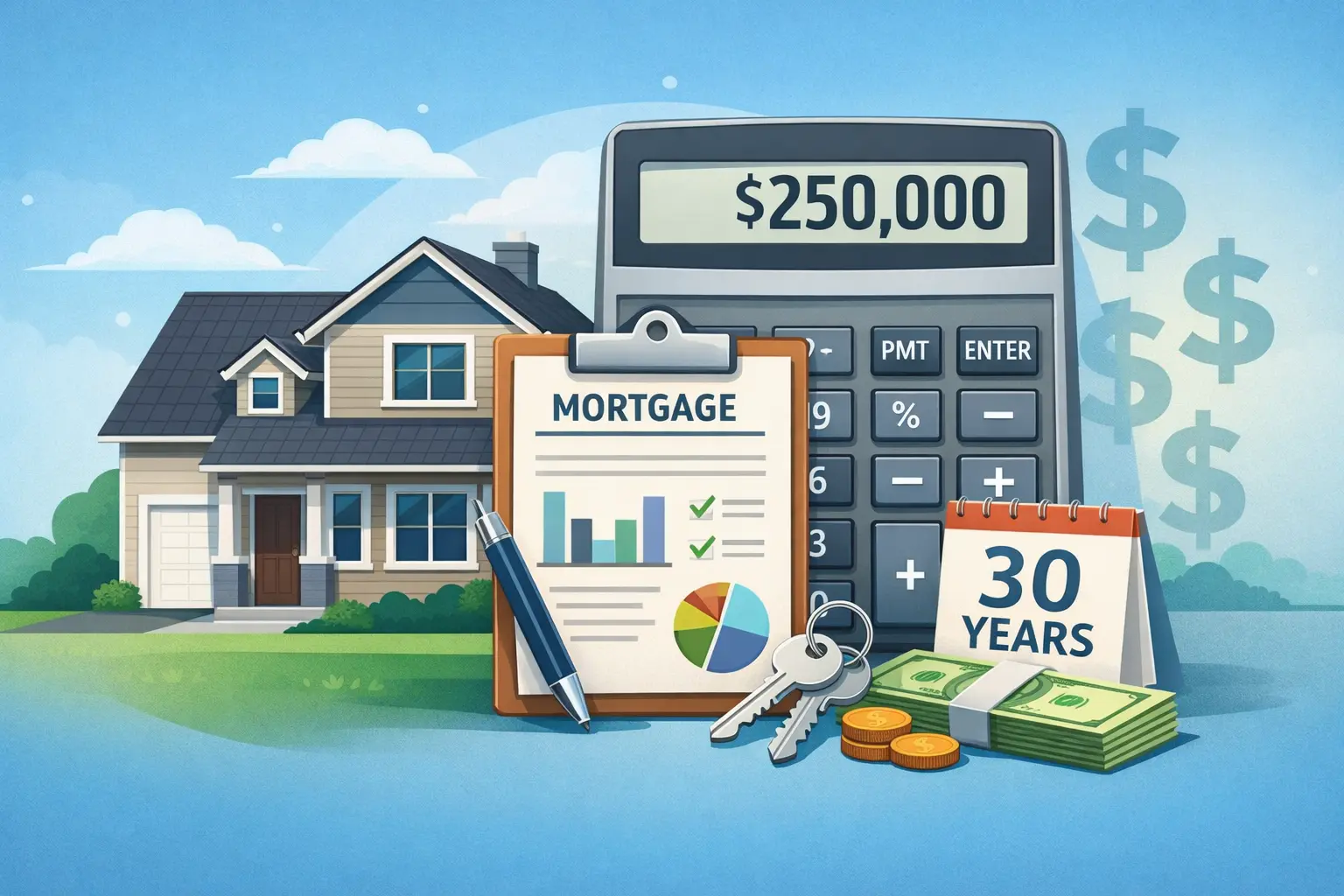
A $250k mortgage 30 years payment represents one of the most common home loan structures in the U.S. housing market. The loan spreads repayment across 360 monthly installments, lowering the required payment compared with shorter terms while increasing total interest over time. Understanding how the payment is calculated, how it changes over the life of the loan, and what additional factors affect overall cost is central to evaluating this type of mortgage.
This report provides a structured, factual explanation of how a $250K mortgage on a 30-year term typically works, including estimated payments, interest effects, amortization behavior, and related cost considerations.
What a 30-Year $250,000 Mortgage Means
A 30-year mortgage is a long-term loan repaid over three decades. The $250,000 amount refers to the principal, or the amount borrowed before interest and other housing-related expenses. Each monthly payment includes two core components: interest charged by the lender and principal applied to the outstanding balance.
Thirty-year mortgages are widely used because they offer predictable monthly payments and lower initial cash flow requirements than shorter-term loans. Most are structured as fixed-rate loans, meaning the interest rate and required payment remain consistent for the full term, providing long-term payment stability.
While the extended term improves monthly affordability, it also increases the total interest paid over time compared with shorter repayment schedules.
Estimated Monthly Payment on a $250K Mortgage
The monthly payment on a $250,000 mortgage depends primarily on the interest rate applied to the loan. The following estimates reflect principal-and-interest payments only and exclude property taxes, insurance, and other costs.
- At approximately 5.0% interest, the estimated monthly payment is about $1,342.
- At approximately 6.0% interest, the estimated monthly payment is about $1,499.
- At approximately 7.0% interest, the estimated monthly payment is about $1,663.
- At approximately 8.0% interest, the estimated monthly payment is about $1,834.
These figures are rounded estimates intended to demonstrate how payments vary with interest rates. Actual payments depend on the precise rate, loan terms, and lender structure.
Payment Breakdown Over Time
A 30-year mortgage uses amortization, meaning payments are structured so that interest is paid first, with principal repayment increasing gradually over time.
In the first month of a $250,000 mortgage at approximately 6.0% interest, roughly $1,250 of the payment may go toward interest, while only about $250 reduces the principal balance. This imbalance reflects the large outstanding balance early in the loan term.
After approximately five years, the interest portion remains dominant, but principal reduction begins to accelerate as the balance declines.
Around the 10-year mark, a more meaningful portion of each payment is applied to principal, though interest still represents a significant share.
By year 20, the balance is substantially lower, and principal repayment makes up a much larger portion of each payment, with interest costs declining accordingly.
This gradual shift is a defining feature of long-term mortgages and explains why equity builds slowly in the early years.
Amortization Summary for a $250K 30-Year Mortgage
Rather than reviewing a full amortization table, the following high-level estimates illustrate how the loan balance typically changes over time at an interest rate near 6.0%.
After 5 years, the remaining loan balance is approximately $232,000.
After 10 years, the balance is approximately $209,000.
After 20 years, the balance is approximately $140,000.
These figures are approximate and vary based on interest rate and payment structure. They illustrate how principal reduction accelerates later in the loan term while early payments primarily cover interest.Borrowers can compare lender-specific estimates using the Wells mortgage calculator to see how rate changes affect monthly payments.
How Interest Rates Affect a $250,000 Mortgage
Interest rates have a substantial impact on both monthly payments and total loan cost. Over a 30-year horizon, even a small rate difference can translate into significant long-term expense changes.
A one-percentage-point increase in interest can raise the monthly payment by more than $150 and add tens of thousands of dollars in total interest paid. Because interest accrues over decades, rate changes affect not only affordability but also lifetime borrowing costs.
Rates are influenced by broader economic conditions, including inflation trends and monetary policy, as well as borrower-specific factors such as credit profile and loan structure.
Costs That Increase the Monthly Payment
The principal-and-interest payment represents only part of the monthly housing cost. Several additional expenses are commonly included in the total payment.
Property Taxes
Property taxes vary by location and are typically collected monthly through an escrow account. Tax amounts depend on local assessments and rates and may change over time.
Homeowners Insurance
Insurance coverage is usually required by lenders and protects the property against damage or loss. Premiums vary based on location, coverage level, and property characteristics.
Private Mortgage Insurance (PMI)
PMI may apply when the down payment is below 20 percent of the home’s value. This cost increases the monthly payment and typically remains until sufficient equity is established.
These items can add several hundred dollars per month beyond the base mortgage payment.
Down Payment Impact on a $250K Mortgage
The size of the down payment directly affects the loan amount and monthly payment.
With a 5% down payment on a home priced around $263,000, the loan amount would remain close to $250,000, and PMI would likely apply, increasing monthly costs.
A 10% down payment reduces the loan balance and may slightly lower the payment, though PMI often still applies depending on lender requirements.
A 20% down payment reduces the loan amount more significantly and typically eliminates PMI, lowering both the base payment and overall monthly housing cost.
Larger down payments reduce interest expense over time by lowering the amount borrowed.
Total Cost Over 30 Years
Over the full 30-year term, total repayment far exceeds the original $250,000 principal due to accumulated interest. At an interest rate near 6.0%, total payments may exceed $540,000, with interest accounting for more than half of the amount repaid.
This long-term cost reflects the tradeoff between lower monthly payments and extended repayment duration.
30-Year vs 15-Year Mortgage Comparison
A 15-year mortgage shortens the repayment period and typically carries a lower interest rate. Monthly payments are substantially higher, but total interest paid is significantly lower.
On a $250,000 loan, a 15-year term may require payments hundreds of dollars higher per month while reducing total interest costs by a wide margin. The choice between terms depends on cash flow priorities rather than a single optimal structure.
Refinancing Considerations
Refinancing involves replacing an existing mortgage with a new loan, often to secure a lower interest rate. If market rates decline, refinancing can reduce the monthly payment or shorten the loan term.
However, refinancing involves closing costs and fees, and the timing of the refinance affects overall savings. The remaining loan balance and expected time in the home are key factors in evaluating whether refinancing changes the long-term cost structure.
Is a $250K Mortgage Affordable?
Affordability depends on income, existing debt obligations, and total housing costs. Lenders typically assess affordability using debt-to-income ratios, which compare monthly debt payments to gross income.
Beyond lender criteria, household budgeting, savings capacity, and long-term financial goals play a role in determining whether a $250,000 mortgage fits within a sustainable financial framework.
Key Takeaways
A $250,000 mortgage on a 30-year term offers lower monthly payments through extended repayment but results in higher total interest over time. Interest rates, down payment size, and additional housing costs materially affect both monthly obligations and long-term expense.
Early payments are heavily weighted toward interest, with principal reduction accelerating later in the loan term. Understanding payment breakdowns, amortization behavior, and cost components provides clarity on how this mortgage structure functions within the broader housing market.
One Reply to “$250k mortgage 30 years payment: Monthly Payment Explained”