
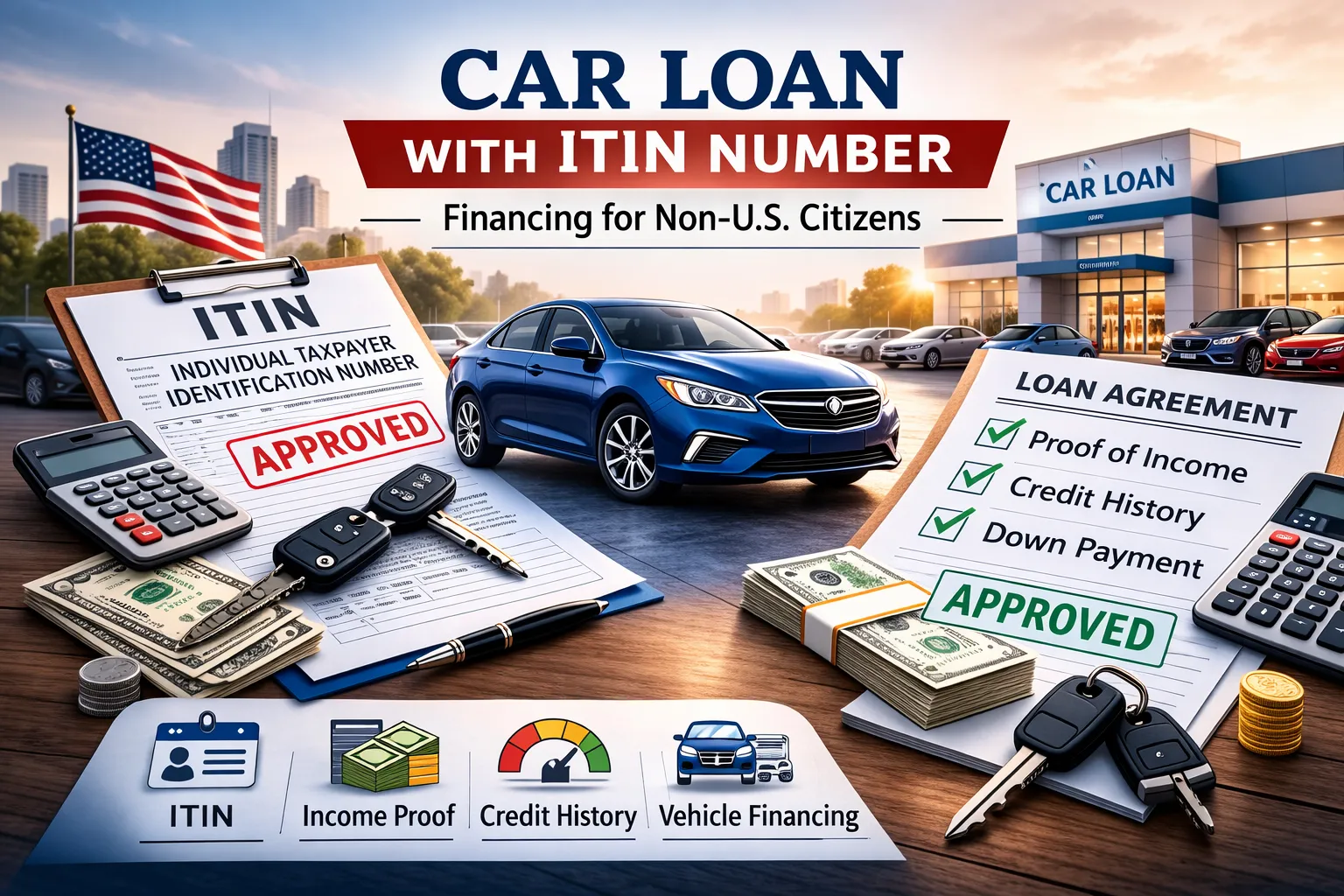
An Individual Taxpayer Identification Number ITIN car loan allows borrowers who do not have a Social Security Number to finance a vehicle in the United States. ITIN lending is common among non U.S. citizens including resident and nonresident taxpayers who file federal tax returns but are not eligible for a Social Security Number.
Auto financing with an ITIN follows similar structural mechanics as standard auto lending. However underwriting guidelines credit verification procedures and documentation requirements differ. This article explains how ITIN car loans work how lenders assess risk and what borrowers should expect during the approval process.
What Is an ITIN
An Individual Taxpayer Identification Number is issued by the Internal Revenue Service for federal tax reporting purposes. It is a nine digit number beginning with the number 9 and formatted similarly to a Social Security Number.
An ITIN does not grant immigration status work authorization or Social Security benefits. Its function is limited to tax identification.
Lenders that offer ITIN car loans use the ITIN in place of a Social Security Number for credit evaluation and reporting purposes when permitted by their underwriting systems.
Can You Get a Car Loan With an ITIN
Yes financing is possible with an ITIN. Many banks credit unions and specialized auto finance companies provide ITIN based loans.
Approval depends on:
Income stability
Length of U.S. residence
Credit history if established
Debt to income ratio
Down payment amount
Because underwriting risk may be perceived as higher lenders often require stronger compensating factors such as proof of consistent employment or larger down payments.
How Credit Is Evaluated With an ITIN
Credit reporting agencies may maintain files associated with an ITIN if the borrower has prior credit activity. Payment histories from auto loans credit cards or installment accounts can be reported under the ITIN.
If no credit history exists lenders may use alternative data such as:
Utility payment records
Rental payment history
Bank account statements
Employment verification
Some lenders apply manual underwriting when automated scoring models are unavailable.
Income and Documentation Requirements
Borrowers typically must provide:
Government issued identification
Valid ITIN documentation from the IRS
Proof of income such as pay stubs or tax returns
Proof of residence
Proof of insurance
Self employed borrowers may be required to submit recent federal tax returns filed under the ITIN.
Lenders assess debt to income ratio by dividing total monthly debt obligations by gross monthly income. Most auto lenders prefer ratios below 45 percent though thresholds vary.
Down Payment Expectations
ITIN auto loans frequently require larger down payments compared to standard prime auto loans.
Common down payment ranges may fall between 10 percent and 25 percent of the vehicle purchase price. A larger down payment reduces the loan to value ratio and lowers lender exposure.
Loan to value ratio is calculated as loan amount divided by vehicle value. Higher loan to value ratios increase default risk because vehicles depreciate rapidly.
Interest Rates on ITIN Car Loans
Interest rates depend on:
Credit profile
Loan term
Vehicle age
Income stability
Down payment amount
Rates may be higher than prime auto loans due to increased perceived risk. However borrowers with strong payment history and stable employment may qualify for competitive terms.
Auto loans are typically structured as simple interest contracts. Interest accrues daily based on the remaining principal balance. The daily interest calculation equals principal multiplied by the annual interest rate divided by 365.
Longer loan terms increase total interest paid even if the monthly payment is lower.
Vehicle Eligibility Requirements
Lenders often impose restrictions on:
Maximum vehicle age
Maximum mileage
Minimum vehicle value
Used vehicles beyond certain age or mileage thresholds may not qualify. This is due to collateral depreciation risk.
Some lenders limit financing to franchised dealerships while others permit private party transactions with additional verification steps.
Title and Lienholder Process
When a car loan is approved the lender becomes the lienholder. The lien is recorded on the vehicle title through the state Department of Motor Vehicles.
In electronic lien states the lien is recorded digitally. In paper title states the lender retains the physical title until the loan is paid in full.
The lien prevents transfer of ownership without satisfying the loan. Once the loan balance is paid the lender issues a lien release and the title can be transferred free and clear.
Insurance Requirements
ITIN borrowers must maintain full coverage insurance including collision and comprehensive coverage.
The lender must be listed as lienholder on the insurance policy. If coverage lapses the lender may purchase force placed insurance which is typically more expensive and protects only the lender’s interest.
Credit Reporting and Score Development
When an ITIN auto loan is reported to credit bureaus payment history contributes to credit file development.
On time payments strengthen credit history and may expand future financing options. Delinquencies late payments or repossessions negatively affect credit standing.
Auto loans generally report 30 60 and 90 day delinquencies if payments are not made on schedule. Repeated delinquency increases repossession risk.
Repossession Risk and Deficiency Balances
If payments stop the lender may repossess the vehicle according to state law.
After repossession the vehicle is typically sold at auction. If the sale proceeds are less than the outstanding loan balance plus repossession costs the remaining amount becomes a deficiency balance.
The deficiency balance remains legally collectible unless discharged through bankruptcy.
Understanding total loan obligation including interest and fees is essential before entering a financing agreement.
Refinancing an ITIN Car Loan
Refinancing may be possible after establishing payment history.
Borrowers typically need:
Six to twelve months of on time payments
Improved credit profile
Stable income
Refinancing may lower the interest rate reduce the monthly payment or shorten the loan term. Approval remains subject to lender underwriting guidelines.
Common Challenges
ITIN borrowers may encounter:
Limited lender participation
Higher required down payments
Stricter verification procedures
Higher interest rates
Providing complete documentation and demonstrating income consistency can mitigate underwriting concerns.
Practical Steps Before Applying
Review your credit history associated with your ITIN if available.
Calculate your monthly budget including insurance fuel and maintenance costs.
Determine an affordable monthly payment rather than focusing only on vehicle price.
Evaluate loan term length and total repayment cost.
Monthly payment is influenced by loan amount interest rate and loan term. Extending the term lowers monthly obligation but increases total interest expense.
Legal and Compliance Considerations
Lenders offering ITIN auto loans must comply with federal and state lending regulations including:
Truth in Lending Act disclosure requirements
Equal Credit Opportunity Act provisions
State usury laws
State repossession statutes
Borrowers should review retail installment contracts carefully including annual percentage rate finance charge total of payments and any ancillary product costs.
Structural Overview
A car loan with an ITIN number functions similarly to traditional auto financing but involves modified underwriting standards and documentation review. Lenders evaluate income stability down payment size and collateral value in place of or in addition to standard credit scoring models.
Maintaining consistent payment history builds credit depth over time. Loan structure including interest rate term length and loan to value ratio determines long term affordability.
Careful review of repayment obligations and title mechanics ensures informed decision making when financing a vehicle under an ITIN.