
What Is Considered a Decent Credit Score for Auto Financing?
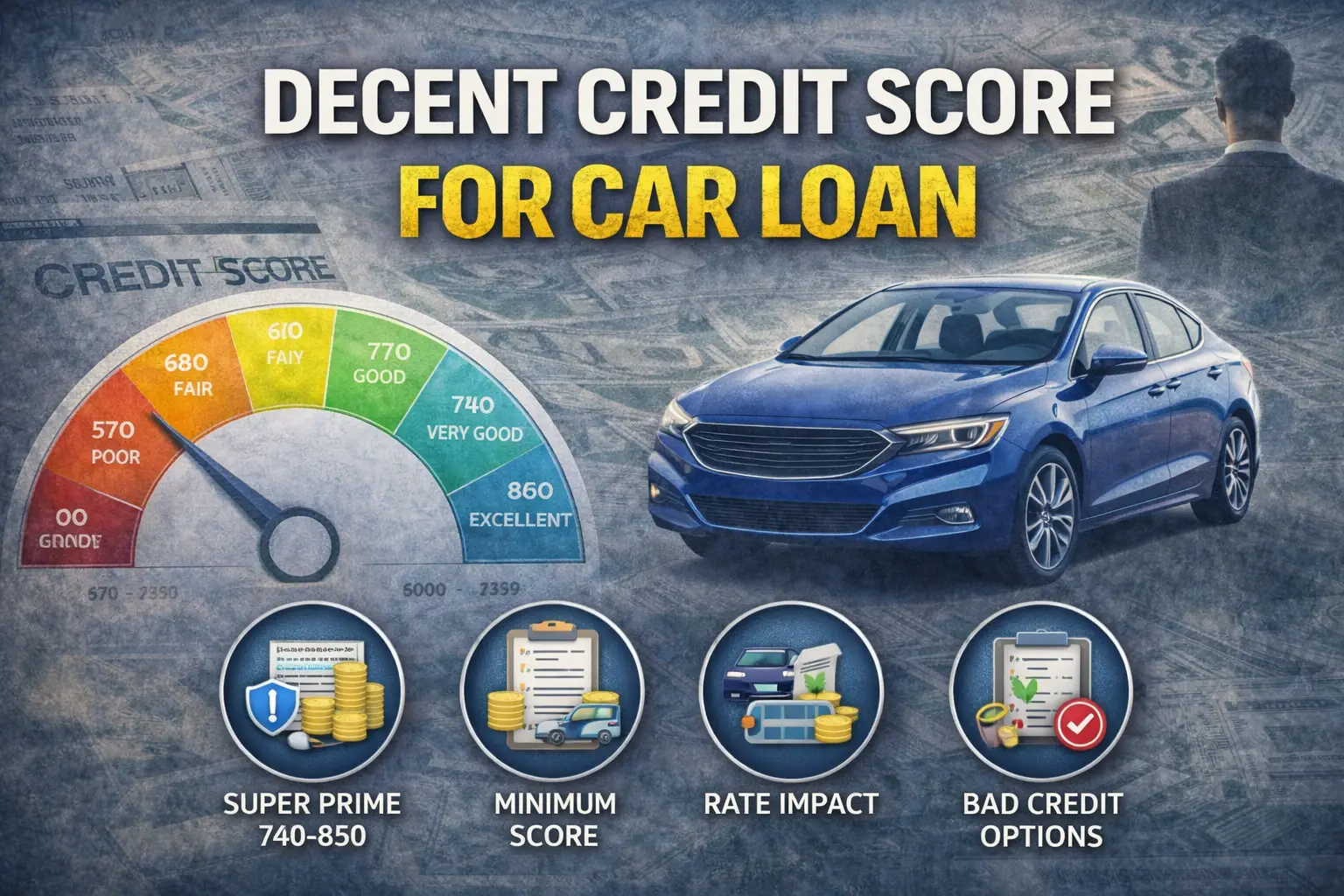
A decent credit score for car loan approval in the United States generally falls within the prime credit tier. While lenders define credit standards differently, most auto financing institutions evaluate borrowers using credit scoring models that range from 300 to 850.
The most commonly used scoring system is the FICO auto score range, which is tailored specifically for auto lending risk. Standard FICO scores range from 300 to 850, but industry-specific auto scores may range from 250 to 900 depending on the version. Higher scores indicate lower predicted credit risk.
Another scoring model used in VantageScore auto lending also ranges from 300 to 850. Although FICO remains dominant in auto financing decisions, some lenders incorporate VantageScore models into underwriting processes.
In general U.S. credit classifications:
- 800–850: Exceptional
- 740–799: Very Good
- 670–739: Good
- 580–669: Fair
- 300–579: Poor
Within auto lending, the distinction between a prime vs subprime auto loan typically determines whether a borrower qualifies for competitive interest rates. A “decent” score usually falls at or above the lower end of the prime tier, often beginning around 660 to 680 depending on lender criteria.
Minimum Credit Score for Auto Loan Approval
There is no universal minimum credit score for auto loan approval. Auto lenders operate under internal underwriting standards and apply risk-based pricing models.
Some lenders may approve borrowers with scores below 600 under subprime programs, while others may require higher thresholds for unsecured lending exposure.
Under a risk-based pricing structure:
- Higher scores qualify for lower interest rates.
- Lower scores result in higher annual percentage rates (APRs).
- Additional conditions may apply to offset risk.
Because underwriting criteria vary, approval is determined by more than credit score alone.
Credit Tiers for Auto Financing
Auto lenders group borrowers into credit tiers for auto financing. These tiers affect rate offers and approval terms.
Super Prime
- Typical score range: 781–850
- Access to the lowest advertised interest rates
- Flexible loan term options
- Minimal underwriting restrictions
Prime
- Typical score range: 661–780
- Competitive interest rates
- Standard loan terms
- Moderate down payment requirements
This range generally aligns with what many lenders consider a decent credit score for car loan eligibility.
Near Prime
- Typical score range: 601–660
- Moderate risk classification
- Higher interest rates than prime
- Possible additional documentation requirements
Subprime
- Typical score range: 501–600
- Higher APRs
- Larger down payment expectations
- Stricter verification of income and employment
Deep Subprime
- Typical score range: 300–500
- Limited lender participation
- Elevated interest rates
- Potential collateral and loan structure restrictions
Borrowers in subprime categories may still receive financing but at higher borrowing costs.
How Credit Score Affects Car Loan Terms
Understanding how credit score affects car loan terms is central to evaluating affordability.
Car Loan Interest Rates by Credit Score
Car loan interest rates by credit score vary significantly across tiers. Super prime borrowers typically receive the lowest APRs, while deep subprime borrowers may face rates several percentage points higher.
Higher interest rates increase total borrowing costs over the life of the loan.
Down Payment Requirements
Lower credit tiers may require larger upfront down payments to reduce lender exposure. Higher-tier borrowers may qualify for minimal down payment financing.
Auto Loan Term Length Impact
The auto loan term length impact differs by credit category:
- Strong credit may qualify for longer terms at competitive rates.
- Subprime borrowers may be restricted to shorter terms.
- Extended terms increase total interest paid even if monthly payments decrease.
Monthly Payment Differences
A higher APR results in higher monthly payments for the same loan amount and term. Credit score therefore directly influences payment affordability.
New Car vs Used Car Loan Credit Requirements
Credit standards may differ between new and used vehicles.
Risk Differences
New vehicles often qualify for lower interest rates due to:
- Manufacturer-backed incentives
- Lower immediate maintenance risk
- Predictable depreciation curves
Used vehicles carry greater uncertainty regarding condition and resale value.
Rate Variations
Lenders frequently charge higher rates for used car financing. Borrowers with marginal credit may find approval standards stricter for older vehicles.
Depreciation Factors
Rapid early depreciation affects collateral value. For used vehicles, lenders assess loan-to-value ratios more conservatively.
Other Auto Loan Underwriting Criteria
Auto lenders evaluate multiple financial indicators beyond credit score.
Debt-to-Income Ratio Auto Loan
The debt-to-income ratio auto loan metric measures monthly debt obligations relative to gross income. Lower ratios indicate stronger repayment capacity.
Income Verification
Lenders require documentation such as pay stubs, tax returns, or employer verification to confirm stable income.
Employment Stability
Length of employment and job continuity factor into underwriting risk assessments.
Credit Utilization Ratio
The credit utilization ratio reflects revolving credit balances relative to credit limits. High utilization may indicate financial strain and reduce approval likelihood.
Secured Auto Loan Risk Assessment
Auto loans are secured by the vehicle itself. Under secured auto loan risk assessment, lenders analyze:
- Loan-to-value ratio
- Vehicle age and mileage
- Market resale value
These factors mitigate default risk but do not eliminate credit-based pricing.
Bad Credit Car Loan Approval Options
Borrowers with lower scores may pursue bad credit car loan approval through structural adjustments.
Larger Down Payment
Increasing upfront payment reduces financed amount and lender risk exposure.
Cosigner for Car Loan
A cosigner for car loan adds an additional obligated party with stronger credit. The cosigner’s credit profile becomes part of the underwriting decision.
Higher APR Expectations
Subprime approvals typically involve elevated interest rates to compensate for higher default risk.
Collateral Considerations
Lenders may limit vehicle selection or impose stricter loan-to-value ratios for high-risk borrowers.
Auto Loan Preapproval Process
The auto loan preapproval process allows borrowers to understand financing eligibility before vehicle selection.
Hard Inquiry Auto Loan
Submitting a formal application triggers a hard inquiry auto loan review on the borrower’s credit report. Multiple inquiries within a short shopping window are often treated as a single inquiry under scoring models.
Rate Shopping Window
Credit scoring models generally group similar loan inquiries within a defined period, often 14 to 45 days depending on the scoring system.
Documentation Required
Preapproval typically requires:
- Identification
- Income documentation
- Employment information
- Social Security number
Preapproval establishes estimated loan terms subject to final verification.
Improve Credit Before Car Loan Application
Borrowers may take measurable steps to improve credit before car loan application submission.
Payment History Importance
On-time payment history constitutes a significant portion of credit scoring models. Delinquencies negatively affect approval odds.
Lowering Credit Utilization
Reducing revolving balances improves credit utilization ratio and may increase overall score.
Correcting Credit Bureau Reporting Auto Loan Errors
Reviewing and correcting credit bureau reporting auto loan inaccuracies ensures lenders evaluate accurate data.
Timeline Expectations
Credit score improvements generally require consistent financial behavior over several months. Rapid short-term increases are uncommon.
Average Credit Score for Car Buyers
The average credit score for car buyers in the United States typically falls within the prime category. Industry data frequently indicates:
- New car buyers: average scores in the low to mid-700s
- Used car buyers: average scores in the high 600s to low 700s
These averages influence national rate trends. Lenders price loans based on aggregate borrower risk profiles. When average credit performance strengthens across borrowers, competitive rate offerings may expand.
However, individual rates depend on specific underwriting criteria, not solely national averages.
Frequently Asked Questions About Credit Score and Car Loans
Q.1 Can you get a car loan with a 600 score?
Ans. A score of 600 generally falls within the subprime category. Approval is possible through certain lenders, though interest rates are typically higher and underwriting conditions stricter.
Q.2 Does checking rates hurt credit?
Ans. A single hard inquiry auto loan application may cause a minor temporary score reduction. Multiple inquiries within a defined shopping window are typically consolidated for scoring purposes.
Q.3 Will paying off a car loan improve credit?
Ans. Paying off an auto loan reduces overall debt. The credit bureau reporting auto loan history remains on the credit report for several years. Score changes depend on overall credit profile and account mix.
Q.4 How long does an auto loan stay on credit report?
Ans. Closed auto loans typically remain on credit reports for up to ten years if paid as agreed. Negative records may remain for approximately seven years.
A decent credit score for car loan approval generally aligns with prime credit tier standards. Lenders evaluate credit tier placement, debt capacity, collateral risk, and documented income to determine rate and approval eligibility under established underwriting frameworks.