
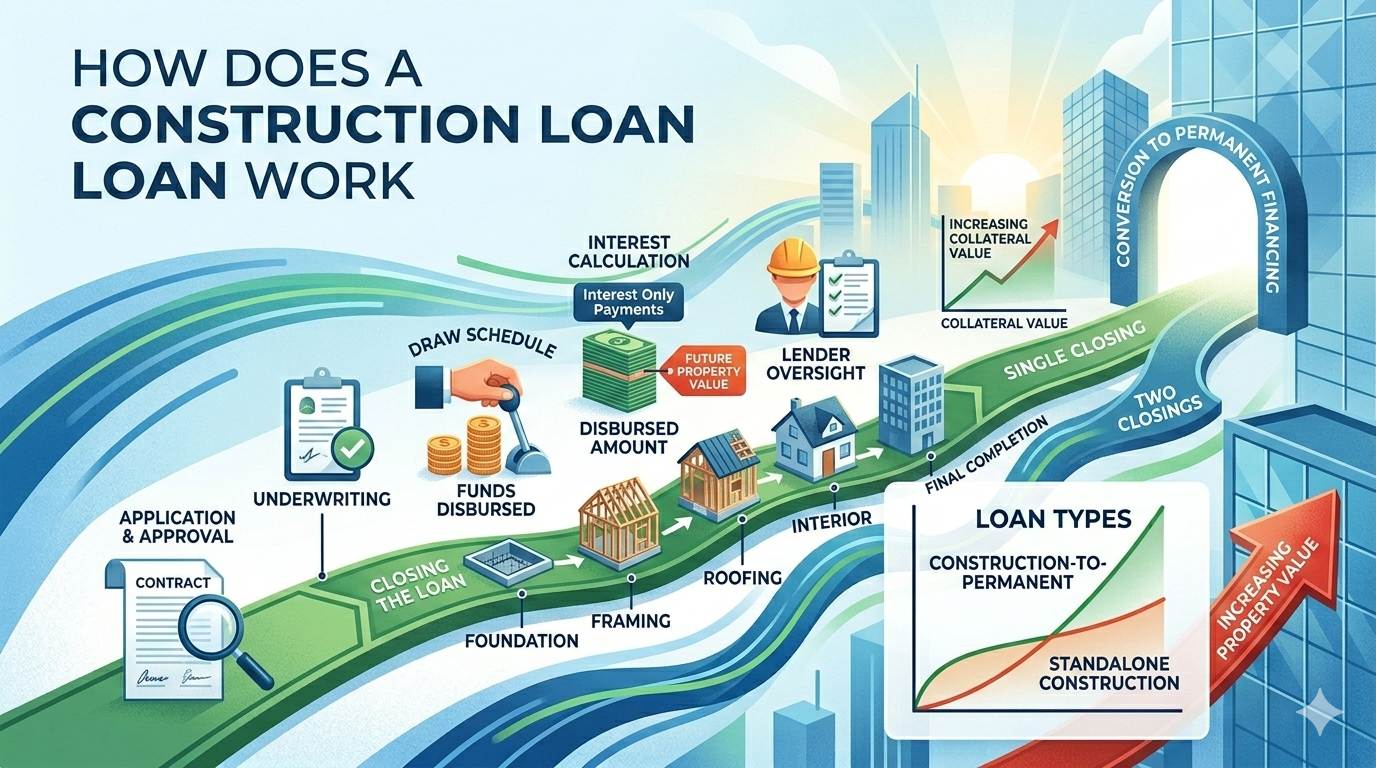
A construction loan is a short-term financing structure used to fund the building of a residential or commercial property. Unlike traditional mortgage loans, construction loans do not provide a single lump sum upfront. Instead, funds are released in stages based on construction progress, and interest is typically charged only on the amount disbursed.
Understanding how a construction loan works requires analyzing its draw schedule, interest calculation method, conversion to permanent financing, and lender oversight during the construction phase.
What Is a Construction Loan
A construction loan is a specialized loan designed to cover the costs of building a property from the ground up or undertaking major structural renovations.
Key Characteristics
- Short-term duration, usually 6 to 18 months
- Funds disbursed in stages (draws)
- Interest-only payments during construction
- Requires detailed construction plans and cost estimates
How Construction Loans Differ From Traditional Mortgages
Construction loans operate under a fundamentally different structure compared to standard home loans.
Primary Differences
Feature Construction Loan Traditional Mortgage Disbursement In stages Lump sum Interest Payments Interest-only during build Principal and interest Term Short-term Long-term Collateral Land + future structure Completed property
The Construction Loan Process
The process involves multiple stages, each requiring lender approval and documentation.
Step 1: Application and Approval
Borrowers must submit:
- Construction plans and blueprints
- Budget and cost breakdown
- Contractor agreement
- Timeline for project completion
Lenders evaluate both borrower creditworthiness and project feasibility.
Step 2: Loan Underwriting
Underwriting focuses on:
- Loan-to-value ratio based on future property value
- Builder credentials and experience
- Borrower income and debt obligations
The future appraised value of the completed property is a key factor.
Step 3: Closing the Loan
Once approved, the loan is closed similarly to a mortgage, but funds are not fully disbursed.
Borrowers may also need to:
- Make a down payment (often 10 to 25 percent)
- Provide proof of land ownership or purchase
Understanding the Draw Schedule
A draw schedule defines how funds are released during construction.
Typical Draw Stages
- Land preparation and foundation
- Framing and structural work
- Roofing and exterior
- Interior systems (plumbing, electrical)
- Final completion
Funds are released after inspections confirm progress.
How Interest Is Calculated During Construction
Interest is charged only on the amount drawn, not the total loan amount.
Example
If the total loan is 300,000 but only 100,000 has been disbursed, interest applies only to the 100,000.
Formula Explanation
Monthly interest equals outstanding drawn balance multiplied by annual interest rate divided by 12
This structure reduces initial payment burden.
Interest-Only Payment Structure
During construction, borrowers typically make interest-only payments.
Benefits
- Lower monthly payments during build phase
- Cash flow flexibility
Limitation
Principal balance does not decrease during this period.
Conversion to Permanent Financing
Once construction is complete, the loan must be repaid or converted.
Two Main Options
Construction-to-Permanent Loan
- Automatically converts into a mortgage
- Single closing process
Standalone Construction Loan
- Requires separate mortgage after completion
- Two closings (higher costs)
Role of the Lender During Construction
Lenders actively monitor the project.
Oversight Functions
- Conduct inspections before each draw
- Verify construction progress
- Ensure funds are used appropriately
This reduces lender risk.
Loan-to-Value Ratio in Construction Loans
LTV is based on the future value of the completed property.
Example
If future value is 400,000 and loan is 300,000:
LTV equals 300,000 divided by 400,000
Lower LTV improves approval chances and reduces risk.
Collateral Requirements
Construction loans are secured by:
- The land
- The partially completed structure
As construction progresses, collateral value increases.
Credit Score and Eligibility Requirements
Borrowers typically need:
- Strong credit profile
- Stable income
- Low debt-to-income ratio
Construction loans carry higher risk, so qualification standards are stricter.
Risks Associated With Construction Loans
Cost Overruns
Unexpected expenses can exceed the approved budget.
Construction Delays
Delays increase interest costs and may affect loan terms.
Market Risk
Property value at completion may differ from projections.
Using Land as Collateral for Construction Loans
Borrowers who already own land can use it as equity.
Benefits
- Reduces required down payment
- Improves loan approval likelihood
Land value is included in total project valuation.
Budgeting and Cost Control
Accurate budgeting is essential.
Components
- Labor costs
- Materials
- Permits and fees
- Contingency reserve
Lenders often require a contingency buffer.
Inspection and Disbursement Controls
Before each draw, inspections confirm:
- Work completion
- Compliance with plans
- Proper use of previous funds
This ensures financial discipline.
What Happens If Construction Is Not Completed
Incomplete projects create financial risk.
Possible Outcomes
- Loan default
- Foreclosure on property
- Requirement to refinance under different terms
Borrowers must ensure realistic timelines.
Comparing Construction Loan Types
Construction-to-Permanent
- Simplified process
- Predictable long-term financing
Standalone Construction
- More flexibility in choosing mortgage later
- Higher closing costs
Managing Cash Flow During Construction
Borrowers must plan for:
- Interest payments
- Living expenses
- Potential cost overruns
Proper planning prevents financial strain.
Common Mistakes to Avoid
- Underestimating construction costs
- Choosing unqualified contractors
- Ignoring contingency planning
- Failing to monitor draw usage
These mistakes increase financial risk.
Practical Example
Scenario
Loan amount: 300,000
Interest rate: 7 percent
Draws
- First draw: 75,000
- Second draw: 150,000
- Final draw: 75,000
Interest is calculated only on the drawn amounts at each stage, reducing early costs.
Answering Common Questions
How Does a Construction Loan Work Step by Step
Funds are approved, released in stages, interest is paid during construction, and the loan converts or is refinanced after completion.
Do You Pay Monthly During Construction
Yes, typically interest-only payments.
Is a Down Payment Required
Yes, usually based on total project value.
Can Land Be Used as Equity
Yes, it can reduce cash requirements.
Structural Insight
Construction loans operate on a controlled disbursement and risk management framework. Unlike traditional loans, they align financing with project progress, ensuring that capital is deployed incrementally. The combination of staged funding, interest-only payments, and post-construction conversion creates a distinct financing model that requires detailed planning and strict compliance with lender requirements.