
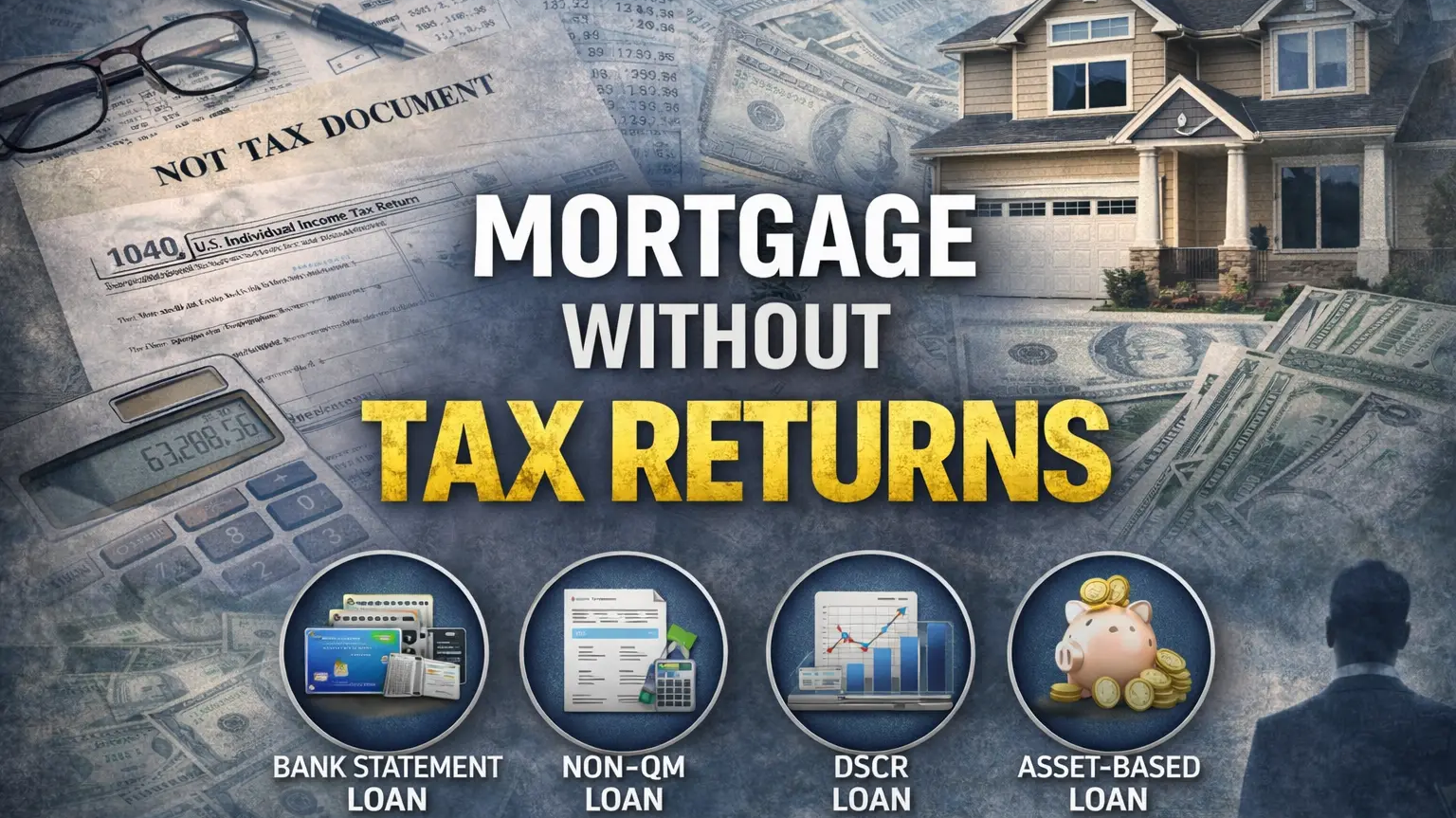
A mortgage without tax returns refers to a home loan program that allows borrowers to qualify using alternative forms of income verification rather than providing full federal tax returns. These programs are typically structured under non-traditional underwriting guidelines and are often associated with non-QM mortgage loan products.
Standard mortgage underwriting relies heavily on tax returns to verify income stability and calculate debt-to-income ratio verification. However, certain loan structures allow alternative documentation methods when borrowers cannot qualify using conventional documentation standards.
Can You Get a Mortgage Without Tax Returns?
The question “can you get a mortgage without tax returns” depends on loan type, income structure, and lender underwriting standards.
Standard Mortgage Income Documentation Requirements
Traditional mortgage income documentation requirements typically include:
- Two years of federal tax returns
- W-2 forms
- Recent pay stubs
- Verification of employment
These documents are used to confirm income consistency, employment stability, and repayment ability under qualified mortgage rules.
Situations Where Tax Returns Are Normally Required
Tax returns are generally required when:
- The borrower is self-employed
- The borrower earns commission or bonus income
- Rental income is used for qualification
- Business ownership exceeds 25%
Tax returns allow underwriters to analyze adjusted gross income, deductions, and overall cash flow.
When Alternative Income Verification Mortgage Programs Apply
Alternative income verification mortgage programs apply when borrowers cannot qualify under standard documentation requirements but can demonstrate repayment ability through other financial records.
These programs often fall under non-QM mortgage loan guidelines. They are not classified as traditional qualified mortgage products and may use manual underwriting mortgage standards.
Why Some Borrowers Seek a No Tax Return Mortgage
Several borrower profiles commonly seek a no tax return mortgage.
Self-Employed Income Variability
Self-employed borrowers often experience income fluctuations. Tax returns may not reflect current earnings if recent income growth has occurred.
Business Deductions Reducing Taxable Income
Business owners frequently deduct operational expenses, reducing reported taxable income. This may limit qualification under traditional underwriting even when actual cash flow is strong.
1099 Income Structures
Individuals earning 1099 income may not receive W-2 documentation. Their income can vary month to month, making conventional mortgage approval without W-2 documentation more complex.
Real Estate Investor Scenarios
Investors often use depreciation and expense deductions that lower taxable income. Programs such as DSCR loan structures allow qualification based on property income rather than personal tax returns.
Types of Mortgage Programs That Do Not Require Tax Returns
Bank Statement Loan
A bank statement loan is a common form of alternative income verification mortgage.
Instead of tax returns, lenders review 12 or 24 months of personal or business bank statements.
Income calculation methods typically include:
- Averaging monthly deposits
- Applying expense factors to business accounts
- Excluding non-income deposits
Eligibility criteria generally include:
- Minimum credit score requirements
- Sufficient bank deposit history
- Stable business operation history
Bank statement loan programs are frequently used by self-employed mortgage without tax returns applicants.
DSCR Loan
A DSCR loan is designed primarily for real estate investors.
DSCR stands for Debt Service Coverage Ratio. It measures rental income compared to property debt obligations.
If rental income covers or exceeds the mortgage payment, the borrower may qualify without personal income documentation.
Investor property standards typically require:
- Non-owner-occupied property
- Sufficient rental income
- Acceptable property appraisal
DSCR loan programs do not rely on borrower tax returns for qualification.
Asset-Based Mortgage
An asset-based mortgage qualifies borrowers using liquid assets rather than income.
Asset depletion calculations divide eligible assets over a defined term to establish qualifying income.
Eligible assets may include:
- Savings accounts
- Investment accounts
- Retirement funds (subject to adjustments)
Asset-based mortgage programs are often used by retirees or high-net-worth borrowers.
Non-QM Mortgage Loan
A non-QM mortgage loan refers to loans that do not meet qualified mortgage rules.
Non-QM loans may allow:
- Bank statement qualification
- Asset depletion income
- Interest-only structures
- Flexible DTI thresholds
These loans follow mortgage underwriting requirements outside conventional government-backed guidelines and frequently require manual underwriting mortgage review.
Self-Employed Mortgage Without Tax Returns
A self-employed mortgage without tax returns typically uses alternative documentation.
Alternative documentation requirements may include:
- 12–24 months of bank statements
- Profit and loss statement mortgage documentation
- Business license verification
- CPA letters
A profit and loss statement mortgage review evaluates gross revenue and expenses. Lenders may require third-party validation or CPA-prepared documentation.
Business license verification confirms operational legitimacy. CPA letters may verify self-employment duration and income stability.
Mortgage Approval Without W-2 or Traditional Income Documents
Mortgage approval without W-2 documentation is possible under limited documentation mortgage programs.
Limited Documentation Mortgage
Limited documentation mortgage structures reduce traditional paperwork requirements while still verifying repayment ability.
1099 Income Mortgage Qualification
A 1099 income mortgage uses deposit analysis instead of W-2 forms. Income may be averaged from bank deposits or supported by third-party documentation.
Employment Verification Alternatives
Alternative employment verification methods may include:
- Business registration records
- CPA statements
- Contract agreements
These methods satisfy mortgage income documentation requirements without relying on tax returns.
Income Verification Methods Used Instead of Tax Returns
Alternative programs rely on structured income verification methods.
Bank Statement Averaging
Lenders review deposits over a defined period. Monthly averages are calculated after excluding non-recurring deposits.
Asset Depletion Formulas
Asset depletion formulas convert eligible assets into a monthly income figure by dividing total qualifying assets over a specified amortization period.
Cash Flow Analysis
Cash flow analysis examines recurring revenue patterns and expense ratios to determine net qualifying income.
Third-Party Verification
Third-party verification may include CPA validation letters or independent business documentation review.
These methods replace standard tax transcript analysis in a mortgage without tax returns scenario.
Debt-to-Income Ratio Verification in No Tax Return Loans
Debt-to-income ratio verification remains a central component of underwriting.
DTI is calculated by dividing total monthly debt obligations by verified monthly income.
Under non-QM mortgage loan programs, DTI limits may differ from qualified mortgage rules. Some programs allow higher ratios if compensating factors exist.
Residual income considerations may apply, particularly in manual underwriting mortgage scenarios. Residual income measures remaining funds after debt obligations.
Credit Score and Down Payment Requirements
Credit score requirements vary depending on program type.
Typical minimum ranges may include:
- Mid-600s for many non-QM programs
- Higher thresholds for certain limited documentation mortgage structures
Loan-to-value ratios differ from conventional programs. Down payment requirements are often higher for no tax return mortgage programs.
Risk-based pricing adjustments may apply based on credit score, LTV ratio, and documentation type.
Mortgage Underwriting Requirements for Limited Documentation Loans
Mortgage underwriting requirements for limited documentation mortgage programs often involve manual underwriting mortgage review.
Underwriters assess:
- Credit history
- Deposit consistency
- Asset stability
- Property value
Compensating factors may include:
- Strong credit score
- Significant cash reserves
- Low loan-to-value ratio
Reserve requirements are typically stricter than qualified mortgage products.
Property eligibility standards may limit certain property types or investment uses.Before applying, it helps to estimate realistic monthly payments using tools such as the Wells mortgage calculator.
Risks and Considerations of No Doc Mortgage Loans
No doc mortgage loans historically allowed minimal verification. Modern limited documentation mortgage programs still require alternative documentation.
Potential considerations include:
- Higher interest rate structures
- Larger down payment requirements
- Increased reserve standards
Regulatory compliance under federal lending laws requires lenders to verify ability to repay, even under non-QM mortgage loan structures.
Common Reasons Mortgage Applications Without Tax Returns Are Denied
Applications may be denied due to:
- Insufficient bank statement history
- Inconsistent deposit patterns
- Unverifiable income sources
- Excessive debt-to-income ratio verification results
- Low credit score
- Insufficient asset reserves
- Property ineligibility
Failure to meet mortgage underwriting requirements under non-QM standards may result in denial.
Timeline for Mortgage Approval Without Tax Returns
The timeline for mortgage approval without W-2 or tax return documentation follows structured stages.
Application Submission
The borrower submits financial information and alternative documentation.
Documentation Review
Bank statements, asset records, and supporting documentation are analyzed.
Underwriting Timeline
Manual underwriting mortgage review may take longer than automated approvals due to additional documentation analysis.
Closing Preparation
After approval, closing documents are prepared and final verification steps occur.
Processing timelines vary based on documentation completeness and underwriting complexity.
A mortgage without tax returns requires alternative income verification methods, structured underwriting review, and compliance with mortgage approval standards that confirm repayment ability without relying on traditional tax documentation.