
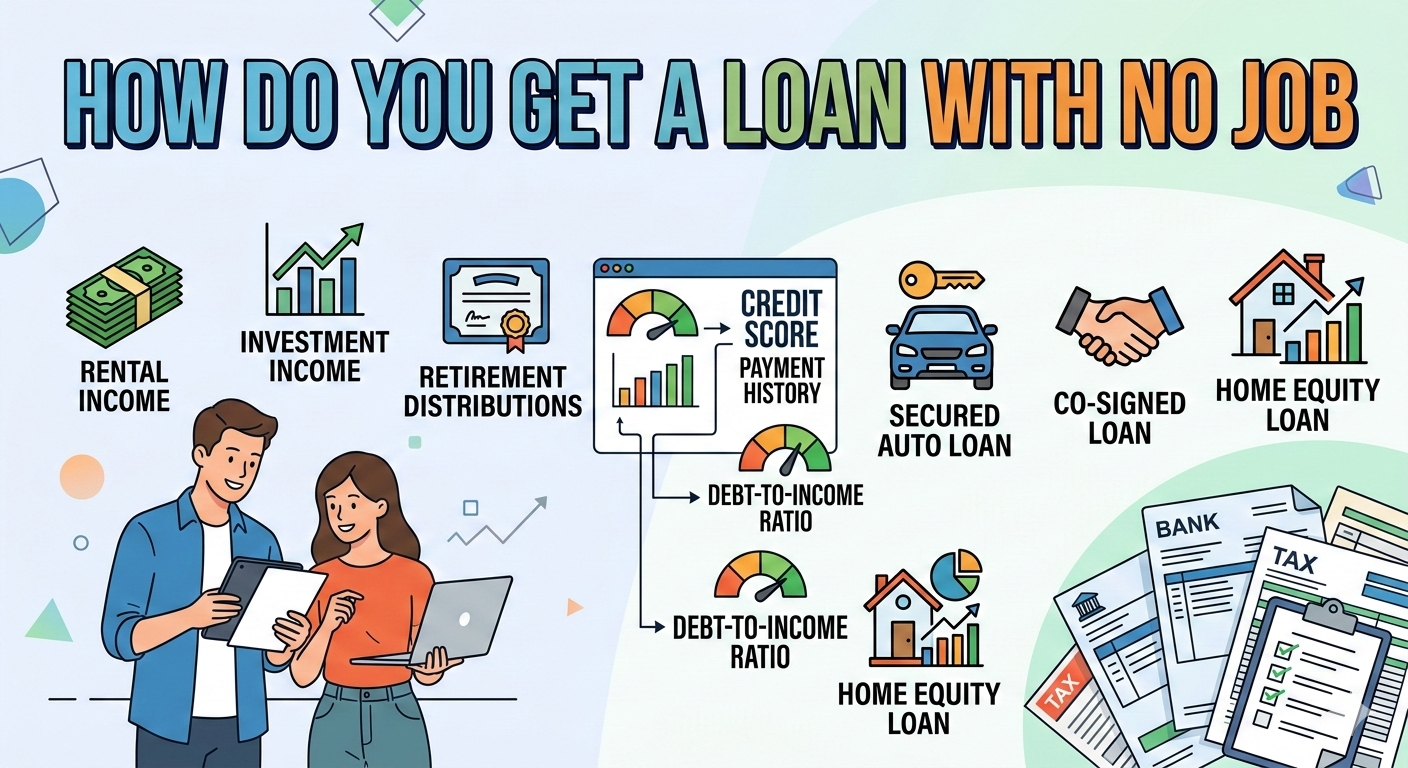
Accessing credit without traditional employment presents structural challenges because lenders rely on income stability to assess repayment capacity. However, loan approval is not strictly limited to salaried borrowers. Underwriting frameworks in the United States evaluate total ability to repay, which can include alternative income sources, asset positions, and credit history.
This article explains how loans can be obtained without a job, how lenders assess risk in such scenarios, and the technical mechanics behind approval decisions. It also clarifies the implications for credit reporting, interest costs, and long-term financial outcomes.
How Lenders Evaluate Borrowers Without Employment
Lenders do not exclusively require employment; they require verifiable income or repayment capacity. The underwriting process focuses on risk modeling rather than job status alone.
Core Underwriting Variables
- Income verification (any recurring source)
- Credit score and payment history
- Debt-to-income (DTI) ratio
- Asset reserves
- Collateral (for secured loans)
If a borrower lacks employment but demonstrates sufficient income or assets, approval remains possible.
Acceptable Income Sources Without a Job
A borrower without formal employment can still qualify if they provide consistent, documentable income streams.
Common Alternative Income Types
- Rental income from real estate
- Investment income (dividends, interest)
- Retirement distributions (401(k), IRA, pension)
- Government benefits (Social Security, disability income)
- Alimony or child support (if consistently received)
- Freelance or contract income
Lenders typically require documentation such as bank statements, tax returns, or award letters to validate these sources.
Debt-to-Income Ratio Without Employment
The debt-to-income ratio remains a primary underwriting metric, even when income is non-traditional.
DTI = total monthly debt obligations ÷ gross monthly income
Example
- Monthly debt = 800
- Monthly verified income = 2,500
- DTI = 800 ÷ 2,500 = 32%
Most lenders prefer a DTI below 43%, though thresholds vary by loan type. Without employment, maintaining a low DTI becomes more critical.
Types of Loans Available Without a Job
Loan structure significantly affects approval probability. Some loan categories are more accessible for borrowers without employment.
Secured Loans
Secured loans reduce lender risk by attaching collateral.
Examples
- Auto loans (vehicle as collateral)
- Secured personal loans
- Home equity loans
Approval depends more on collateral value and less on employment status.
Unsecured Personal Loans
Unsecured loans rely heavily on creditworthiness and income verification.
- Higher credit scores improve approval chances
- Interest rates are typically higher without stable employment
- Lenders may impose lower borrowing limits
Co-Signed Loans
A co-signer with stable income can strengthen the application.
- The co-signer assumes legal responsibility for repayment
- Improves approval odds and may reduce interest rates
- Appears on both parties’ credit reports
Asset-Based Loans
Some lenders approve loans based on liquid assets rather than income.
- Savings accounts
- Investment portfolios
- Certificates of deposit
These loans may involve asset pledging or liquidation risk.
Credit Score Requirements and Risk Assessment
Credit scoring plays a central role when employment is absent.
Key Credit Factors
- Payment history (largest weighting factor)
- Credit utilization ratio
- Length of credit history
- Credit mix
- Recent inquiries
A higher credit score compensates for lack of employment by demonstrating repayment reliability.
Interest Rates and Risk-Based Pricing
Lenders apply risk-based pricing models when evaluating borrowers without jobs.
Risk Adjustments
- Higher annual percentage rates (APR)
- Additional fees or stricter terms
- Shorter repayment periods
Interest cost increases reflect uncertainty in repayment capacity.
Amortization and Loan Structure
Loan repayment follows an amortization schedule, regardless of employment status.
Monthly payment formula:
M = P × [r(1 + r)^n] ÷ [(1 + r)^n − 1]
Where:
- P = loan principal
- r = monthly interest rate
- n = number of payments
Each payment includes both principal and interest, with early payments weighted toward interest.
Per Diem Interest and Timing Considerations
For certain loans, especially mortgages or large personal loans, interest accrues daily.
Per diem interest = (loan amount × annual interest rate) ÷ 365
Without steady income, timing of payments becomes critical to avoid accumulating excess interest.
Collateral and Loan Security Mechanics
Collateralized loans shift risk from income-based repayment to asset-backed recovery.
Collateral Valuation Factors
- Market value of the asset
- Loan-to-value (LTV) ratio
- Liquidity of the asset
If the borrower defaults, the lender can repossess or liquidate the collateral to recover losses.
Loan-to-Value (LTV) Ratio
For secured loans, LTV is a critical metric.
LTV = loan amount ÷ collateral value
Example
- Loan amount = 10,000
- Collateral value = 15,000
- LTV = 66.7%
Lower LTV ratios reduce lender risk and improve approval chances.
Risks of Borrowing Without Employment
Borrowing without a stable job introduces higher financial risk.
Primary Risks
- Income instability leading to missed payments
- Increased interest costs
- Higher probability of default
- Limited refinancing options
Deficiency Balances in Secured Loans
If collateral is repossessed and sold, proceeds may not fully cover the loan balance.
Deficiency balance = remaining loan balance − sale proceeds
Borrowers remain legally responsible for any deficiency, even after asset liquidation.
Credit Reporting and Payment History
Loan performance is reported to credit bureaus regardless of employment status.
Reporting Impacts
- On-time payments improve credit score
- Late payments reduce credit score
- Defaults and charge-offs significantly damage credit
Maintaining payment consistency is critical for long-term credit access.
Role of Cash Reserves and Liquidity
Lenders often evaluate liquid reserves when employment is absent.
Common Reserve Metrics
- Number of months of expenses covered
- Savings account balances
- Emergency funds
Strong reserves can offset lack of employment in underwriting decisions.
Documentation Requirements
Borrowers without jobs must provide more extensive documentation.
Typical Requirements
- Bank statements (3–12 months)
- Tax returns (1–2 years)
- Proof of alternative income
- Asset statements
Incomplete or inconsistent documentation reduces approval probability.
Alternative Financing Options
When traditional loans are not accessible, borrowers may consider alternative structures.
Examples
- Peer-to-peer lending platforms
- Credit union programs
- Secured credit lines
These options still require repayment capacity verification.
Regulatory Considerations
Lenders must comply with ability-to-repay standards under federal regulations.
Key Compliance Elements
- Verification of income or assets
- Assessment of borrower’s financial obligations
- Documentation retention
Failure to meet these standards can render a loan non-compliant.
Practical Approval Scenarios
Approval without employment is more likely under specific conditions:
- High credit score with strong payment history
- Significant liquid assets
- Low existing debt obligations
- Presence of a qualified co-signer
- Collateral with low LTV ratio
Each factor reduces perceived lender risk.
Strategic Considerations for Borrowers
Borrowers without jobs should evaluate repayment sustainability before applying.
Key Considerations
- Stability of alternative income sources
- Total monthly obligations
- Interest cost over loan term
- Risk of asset loss in secured loans
Loan approval does not guarantee affordability, making pre-borrowing analysis essential.
Structural Limitations in Lending Without Employment
Despite available pathways, structural constraints remain:
- Limited lender participation
- Higher underwriting scrutiny
- Reduced loan amounts
- Stricter terms and conditions
These constraints reflect the increased uncertainty associated with non-employed borrowers.
Operational Summary
- Employment is not strictly required for loan approval, but verifiable income or assets are mandatory
- Lenders prioritize repayment capacity through income, credit history, and collateral
- Secured loans and co-signed loans offer higher approval probability
- Interest rates are typically higher due to increased risk
- Credit reporting and legal obligations remain identical to employed borrowers
Borrowers without jobs can access credit under defined conditions, but underwriting standards remain centered on measurable financial capacity rather than employment status alone.